July 14, 2011

Dr. King Thanks CCASM Volunteers

On July 14 Dr. Julia King thanked the CCASM members that volunteered to help process artifacts from Notley Hall.  CCASM's help in the lab allowed Dr. King's crew to spend more time in the field at Windy Knoll, the possible Piscataway Fort.

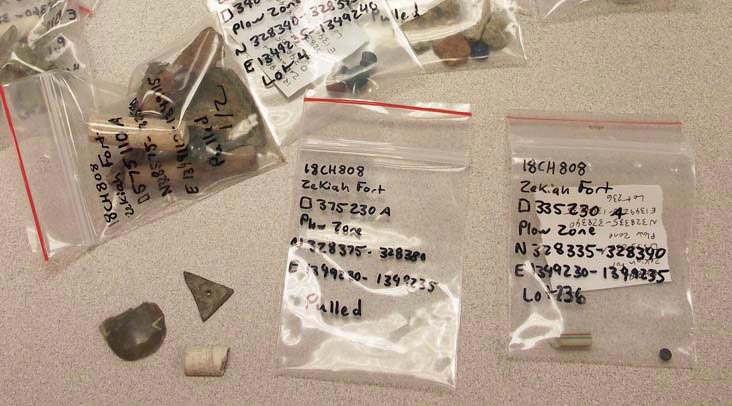
Dr. King shared photos of the work done this year at Notley Hall and at the Windy Knoll.  There was also an opportunity to looks at the artifact distributions and to try  to understand what the distributions might indicate.  Some of the contact period artifacts found at Windy Knoll are shown below.  You should see a copper point, a gun flint, a white tobacco pipe stem with a maker's mark, and glass trade beads.


Not all the volunteers were able to come to the informal show and tell.  But for those who could,  Julie took to lunch at the Front Porch in Leonardtown.

It was quite a nice "thank you".

June 30, 2011

Thanks to Sheila Smith

CCASM would like to thank Sheila Smith for her generous donation.

As she requested, CCASM is using the money to fund a grant for Peter Quantock's magnetometer and ground penetrating radar research in Port Tobacco Village.

CCASM appreciates their efforts in increasing the archaeological knowledge of Charles County.

(Peter is currently working on a Masters in Anthropology at the University of Denver.   He was a charter member of CCAS and part of the Port Tobacco Archaeological Project.)

June 22, 2011

Volunteering for Dr. Julia King

This summer Dr. Julia King was once again looking for the Piscataway Indian Fort in the Zekiah Swamp in Charles County.  And CCASM volunteered to help.

But first Dr. King and her crew worked at the Notley Hall site at the mouth of the Wicomico.  Notley Hall was the home of Thomas Notley, the seventh Maryland governor.

Polly, Rich, Carol, Carole (June 3)


Elsie (June 22)
Members of CCASM volunteered over 130 hours.  They helped wash, bag, and count the artifacts from the 250+ shovel test pits dug at the Notley Hall site.  CSM had provided a lab in which to process the artifacts.

Those participating included Carol Cowherd, Joshua Eller, Rob Gibbs, Rich Gorski, Elsie Picyk, Carole Raucheisen, Carol Starnes, and Polly Zimmerman.

Pictured below is Dr. Julia King and two of her crew, Scott and Skylar in the lab.  Skylar supervised our labs.

Julie King, Scott, and Skylar

June 19, 2011

2011 ASM Field Session

The 2011 ASM Field Session was June 10 – 20 at the Barton Site in Allegany County, and three of our CCASM members were able to attend.

Rich troweling
Belinda with ceramic sherd
Carol removing post mold

Rich is troweling in one of the northern units looking for additional sections of a Page palisade.  Belinda is holding a piece of pottery that may predate the Page occupation and was found in one of the southern units.  Carol is working in a unit with part of the deep Susquehanna storage pit (later trash pit) that cut through a Page occupation feature.

Looking south
Looking north


Roy Brown
Bob Wall and Charlie Hall
Dr. Robert Wall of Towson University is the principal investigator.  He is pictured at right with Dr. Charlie Hall, the
Maryland State Terrestrial Archeologist.

Also pictured at the right is Roy Brown, the president of the Western Maryland Chapter of ASM that has been volunteering with Dr. Wall at the site for the past several years. Roy provided the atlatls and a target that we tried to hit.

The Barton site is part of a series of prehistoric sites that contain artifacts dating from the Paleo-Indian period to Contact times. It was purchased in 2002 by The Archaeological Conservancy, a non-profit organization dedicated to acquiring and preserving archaeological sites.

Click on  Barton Village Site to find out more about the site and about work done there in previous years.

June 11, 2011

At River Artsfest

CCASM was at River Artsfest in Indian Head on Saturday June 11.


Carol Cowherd, Joshua Eller, Elsie Picyk were kept busy with all the people that stopped at the CCASM booth.  They had a lot of conversations with people, some of whom had historic or prehistoric sites on their property.  Also many people were just interested in the various artifacts and information being displayed.  Several commented on how interesting the booth was.  We handed out over forty fliers.

We would like to thank Dr. James Gibb for allowing us to use the Port Tobacco Display and for providing the tent.  We would also like to thank the River Artsfest organization for the opportunity to participate.