Showing posts with label (2-Fieldwork). Show all posts

July 27, 2026

Returning to Rich Hill - 2026

In 2021 a mid-nineteenth century Corn House was to be moved to Rich Hill, a historic property owned by Charles County, and we had to find an area away from the house where there were no artifacts.  Rich Hill-2021  We found that area and the Corn House was moved.  However, while looking for an area with no artifacts, we also found an area with artifacts - mostly nineteenth century.  This appears to be the location of a cabin. 

In 2025 Esther Read along with CCASM members and other volunteers returned to that site at Rich Hill to learn more about who might have occupied this cabin that was far from the main house but close to an old road.  Rich Hill-2025  If none of the artifacts found date after 1865, the cabin could have been a slave cabin.  If a number of artifacts found date after 1865 the cabin could have been used by formerly enslaved people but may also have previously been a slave cabin.  

In 2026 the Historical Society of Charles County received a check from the Maryland House and Garden Pilgrimage for the building of the Ghost Structure at the Rich Hill Cabin Site.  The Ghost Structure at Rich Hill is dedicated to interpreting and preserving the historic landscape, and to honoring the lives and enduring legacy of the enslaved men, women, and children who lived and labored on this property.

--------

On the weekend of July 25 and 26 the units at Rich Hill were finally done! Excavation is complete; paperwork is complete; photos and drawings are complete. This weekend's crew included Claudia, Linda, Denise, Jim Gibb, Tim Doyle, and an old dig buddy Gareth Lewis. Thanks to all that helped.
Thanks to Esther for this update 

Working on another unit

On Monday July 20 Denise, Malinda, Rich, Caleb, Caleb's grandma Carol, and Philip joined Esther at Rich Hill.  We finished excavating Unit 21. All that's left to do with that unit is the final trowel down, photos, and profiles, oh and that pesky paperwork. Now we turn to Units 18 and 19, which we partially excavated when the soil was like concrete.
Thanks to Esther for this update and the photo.

On Monday July 13 Rich and Elsie joined Esther at Rich Hill and helped her finish Unit 20 of the Ghost Structure Site.  After Rich and and Elsie left, Esther worked on the feature at the base of the unit. The feature was a long trench with a post at one end of it - so it was actually two features. We thought we might have a post on Saturday because there was a lot of brick concentrated on the top of a small section of the trench. The trench itself was very shallow. Esther's thinking at this point is it was either a post and a drip line from a structure, or we could be looking at a garden fence known as a post and pale fence. These were common in the 18th and 19th century. A ditch was dug between the posts, then rails were spread horizontally between the posts, and the palings were attached vertically to the rails so that the ends went into the trench. It was primarily a way to keep animals out of the garden - or within the fenced in area. These features have been drawn, excavated, photographed, profiled, and Esther got soil samples for flotation - there was a lot of charcoal in the trench. Nothing is left in Unit 20 and now we turn to Units 19 and 21, which we partially excavated when the soil was like concrete.
Thanks to Esther for this update. 

Piscataway
point

Saturday June 20 Esther and Rich finished digging unit 20 down to subsoil.  The soil is hard - as it is everywhere in the county due to the lack of rain - but we're down almost a foot at the base of the Plow Zone in unit 20.  We have to put a small 2x2 ft unit into the corner to finish out the subsoil level.  We're still working on units 21 and 22. Unit 18 is almost down to the subsoil. Esther is still trying to figure out exactly where Unit 19 should go - it will be over the door post location.
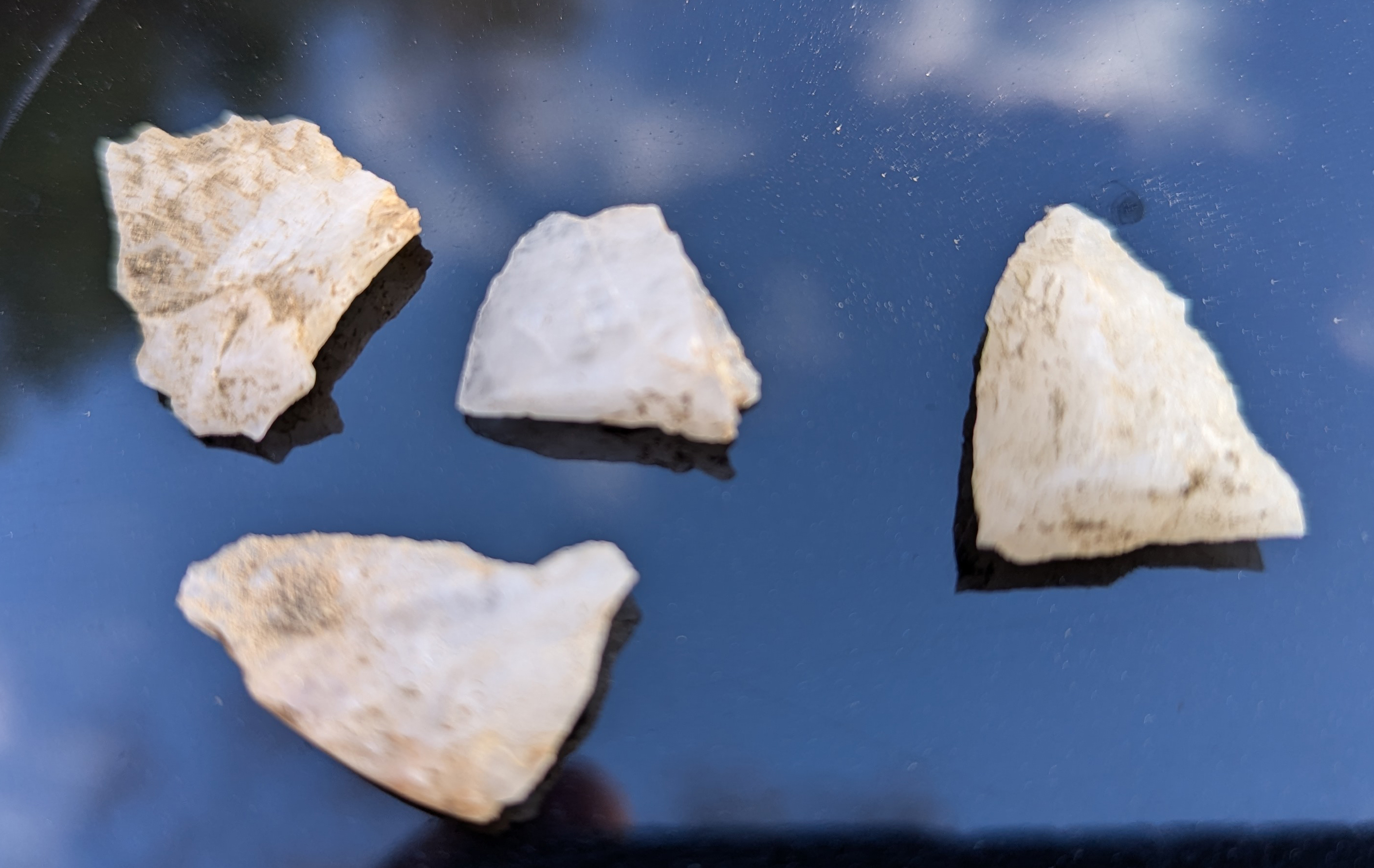
Claudia and Elsie along with Aaliyah and Trevan from Advanced Agricultural  General Contracting screened.  There were lots of ceramics, a couple of nails - including rosehead ones, glass, fire cracked rock and a Piscataway projectile point (Late Archaic/Early Woodland).  The point was chosen as the artifact of the day.

Advanced Architectural General Contracting, the contractor for the ghost cabin, provided mid-morning snacks and lunch.  Rich Hill docents Mike and Jane visited us at lunch, and we had another set of visitors  in the afternoon.
Thanks to Elsie and Esther for the info and to Esther for the photo. 

April 27 Esther was at Rich Hill to dig small units for the Ghost House footers.  The dig went well.  We opened two units but did not finish. We'll be going back, not sure of the dates yet. We have through the end of July to get this done. Thanks to Ned for mowing around the units.  Melinda and Claudia helped with the set up and ran the screens. We have three new volunteers who came out to help.  
Thanks to Esther for the info.
(Note: Rich Hill still has poison ivy, and the roots may show up in the screens.  Claudia and Melinda were the only ones willing to possibly get poison ivy, and they did.)

July 2, 2026

2026 Public Archaeology Days (Apr-Jun)

CCASM has been working with Charles County at the ongoing Public Archaeology Lab since 2015.  The lab is for processing artifacts recovered from various archaeology initiatives in Charles County -  including artifacts from investigations of sites on County properties, artifacts recovered from savage archaeology in the County, as well as artifacts recovered around the 1970's before the Port Tobacco Courthouse was reconstructed.  Esther Read is the archaeologist in charge.

Here is what we were doing the second quarter of 2026.
------------------------------------------------------------------   

Mulberry Grove artifacts
On June 29 Elsie and Linda stayed cool in Burch House.  Linda sorted and bagged artifacts from Swann and Mulberry grove while Elsie washed artifacts from Swann.  The screen shows some of the artifacts recovered from Mulberry Grove.  Esther indicated that finding the Rhenish stoneware and the yellow ceramic floor tiles may mean we have found the original 18th century kitchen.
Rich, Denise, Caleb, Claudia and Esther braved the humidity at the Swann site.  Claudia and Denise  screened while Rich dug and Caleb alternatively assisted Rich or Claudia and Denise.  Esther worked on still another  plow scar and did some documentation paper work.
After lunch Rich and Claudia went to Rich Hill to cover the units with plastic with the hopes of keeping some of the moisture from recent rains in the units.

Thanks to Elsie for info and photo.

On June 15 Linda, Claudia, and Kathy were in the Lab at Burch House sorting and bagging artifacts from Rich Hill and from the Swann site.  I think the drying screens are empty again.  These two sherds with an interesting design were chosen for the artifact of the day.  They were recovered from Rich Hill and appear to be from the same vessel.
Meanwhile upstairs at the Courthouse Lab Esther and Elsie selected Rich Hill artifacts to be used in a CCASM display at a Rich Hill event in July.

Thanks to Elsie for info and to Linda for photo.

June 8 - in field at Swan site - no info

On June 1 most of us were in the field at the Swann Site.   Esther excavated yet another plow scar.  Rich continued digging out the unit we had opened last time we were there.  Claudia, Elsie, and Mimi mostly screened.  Caleb assisted Rich digging but also did some screening and some work on the plow scar.  Because of a bad shoulder Linda processed artifacts at Burch House.  She chose this brick corner fragment as the artifact of the day.

The volunteers
   
Brick fragment

Thanks to Elsie for info and to Linda and Esther for photos.


May 18 - in field Mulberry Grove - no info.   

Rhenish salt glazed stoneware
(penny for size reference)
To coincide with the Maryland House and Garden Tours on Saturday May 16 Esther had been asked to investigate a small area at historic Mulberry Grove.  Elsie, Melinda, Kathy, Linda, Doug, Denise, Claudia joined Esther to put in 4' X 4' unit next to where the homeowner had found 'blue & white ceramics'.  The owners thought it was a privy site, but the soil was like concrete.  Denise, Esther, Elsie, and Doug took turns trying to shovel, making very slow progress.  Claudia frequently sprayed down the  unit with water but that still didn't help much.  When not shoveling most of us joined Linda & Malinda with screening.  At first we were finding mostly modern artifacts.  We eventually stopped skim shoveling, and Linda, Elsie, and Esther troweled,.  Sometimes we had to use a brick hammer to break up the soil. Since there was no observable differences in soil color or texture, Esther decided to determine the strata by arbitrary depths as opposed to looking for soil changes. We took half of the unit down through a second strata and began to find much older artifacts - Rhenish salt glazed stoneware, whiteware, two ceramic floor tiles, plus some prehistoric artifacts. We chose the Rhenish sherd as the artifact of the day.  Most of the oldest material was found embedded in the northern wall. On Monday we will probably put in a small unit extending one foot to two feet from the north wall of the original unit.

We were digging right next to the visitor parking area and interacted with many visitors.

Trying to trowel unit
(water sprayer in foreground)
Looks like screeners are
having more fun

Thanks to Elsie for info and Esther for photos.

Blue Flow Rim


Due to the weather we could not be in the field on May 11.  Linda, Denise, Elsie, Evie, Claudia, and Rich were at Burch House with Esther.  Everybody was in different rooms doing different tasks but we did choose this flow blue rim as the artifact of the day.  It had been recovered during the recent excavations at the Rich Hill.
Thanks to Claudia for the photo and the info.

April 20 while Esther was away, Linda showed Denise, Elsie, Claudia, and Carol the possible activities she would be using at the "CCASM" talk she is giving at the Library this coming Saturday and next Thursday.  We had thought one would be more for children and one would be more for teens and adults, but the library advertised both for children.  Then Linda reviewed the new annual Photo contest that SRPT is having.  Linda has been quite busy.  Then after lunch it was back to cataloging 1970s PT artifacts.  Elsie and Denise worked on miscellaneous while Carol and Linda worked on pearlware.

April 13 was an interesting day at Burch House.  Outside Linda, Malinda, and Elsie created a flower garden behind Burch House in an area that had been cleared of weeds.  They laid down cardboard, covered that with soil, and scattered lots of different types of flower seeds in a relatively small area.  It will be interesting to see how this turns out.  Inside Carol and Esther looked at nails recovered from behind Stagg Hall and verified that most of the nails had been machine cut - somewhat of a surprise.

The April 6 Lab day was part clean up day and a little bit of lab work at Burch House.  The inside of Burch House was in a little bit of disarray after the "Rich Hill" furniture that was being stored at Burch House was finally able to be moved to Rick Hill.  Linda, Denise, Elsie, Claudia, Evie, Kathy, Malinda, and Carol were there to help - rearranging the remaining furniture, dusting, and sweeping up (a lot of stink bugs).  Elsie and Claudia went outside to weed the area near the road.  Linda, Denise, and Evie inventoried the bags and other supplies and did miscellaneous other things.  Kathy, Malinda, and Carol started combining and processing three screens for FS23 from Swann Site.  

2026 Public Archaeology Lab Days (Jan-Mar)
2025 Public Archaeology Lab Days (Oct-Dec) -- 2025 Public Archaeology Lab Days (July-Sep) 
  -- 2025 Public Archaeology Lab Days (Apr-Jun) -- 2025 Public Archaeology Lab Days (Jan-Mar)  
2024 Public Archaeology Lab Days (Oct-Dec)
 --2024 Public Archaeology Lab Days (July-Sep) 
  --2024 Public Archaeology Lab Days (Apr-Jun)  --2024 Public Archaeology Lab Days (Jan-Mar)
2023 Public Archaeology Lab Days (July-Dec) --2023 Public Archaeology Lab Days (Jan-June)
2022 Public Archaeology Lab Days (July-Dec) --2022 Public Archaeology Lab Days (Feb-Jun)
2021 Public Archaeology Lab Days (Mar-Dec)

2020 Public Archaeology Lab Days (Sep-Dec) --2020 Public Archaeology Lab Days (Jan-Mar)
2019 Public Archaeology Lab Days (Jul-Dec)   --2019 Public Archaeology Lab Days (Jan-June)
2018 Public Archaeology Lab Days (July-Dec) --2018 Public Archaeology Lab Days (Jan-June)
2017 Public Archaeology Lab Days (July-Dec) --2017 Public Archaeology Lab Days (Jan-June)
2016 Public Archaeology Lab Days (July-Dec) --2016 Public Archaeology Lab Days (Jan-June)
2015 Public Archaeology Lab Days


May 3, 2026

2026 Port Tobacco Market Day

The Society for the Restoration of Port Tobacco's Seventeenth Annual Market Day was held May 2 in Historic Port Tobacco Village.  CCASM was there as well as local craft vendors, the garden club plant sale, a white elephant sale, and tables for various nonprofits.  And what would a market day outside a courthouse be without musicians?  Everything from banjos to the youth orchestra.  

CCASM put out its display highlighting some of the history of Port Tobacco including some of the results from archaeology done around 2008 in the Historic Port Tobacco Village and most of the visitors stopped by to look at this display.  We have had the display for a lot of years, but it always seems to attract people.  A visit to the CCASM tent would not be complete without there being some activity.  This year we had  an activity that highlighted the three different type of ceramics- earthenware, stoneware, and porcelain.  A potter stopped by to talk to us about some of the ceramics.  So we had an opportunity to learn.  We also had two flag "plates" for people to mend, but only had one person who tried.  We talked to so many people who expressed an interest in archaeology.  It was a very good day (in spite of being so cold). 

CCASM's Table

Public Archaeology is that way
Since the ASM Field Session will be in Charles County again this year, we made sure to tell everyone about this unique opportunity.  In case people didn't know what people do a field session, we had a display showing what to expect, and a number of people scanned the QR code.

Public Archaeology was occurring at the same time at the Swann Site to the southwest of the Courthouse.  We directed a number of people to the site where CCASM members Denise and Elsie were assisting Esther Doyle Read, the Charles County Archaeologist.  

Esther with CCASM volunteers (some helping, some watching)
and a boy that volunteered most of the day.

Thanks to Linda, Claudia, and Carol for representing CCASM at this event.  Also thanks to Linda and Doug for providing the table and the large tent.


November 26, 2025

Investigating the James Swann Site - 2025

CCASM and other Monday volunteers are working with Esther Read to continue the investigation of the James Swann Site that is now owned by Charles County.  James Swann was a "free man of color" (believed to be Native American) that acquired land in Port Tobacco in 1840's and operated a tavern and oyster house in the village for almost twenty-five years. 

Check Public Archaeology Lab Days post for weekday schedule.

Tobacco Pipe 
Bowl Fragment

 Monday November 24 was our regular day to be at Port Tobacco, and everyone was at the Swann Site.  It was one of those nice days to be outside.  Linda, Denise, and Carol along with Esther troweled most of the two plow scars in the northwest unit.  It was Linda's first time to trowel, and her plow scar had nails, window glass, white ceramics, as well as a tobacco bowl fragment that we chose as the artifact of the day.  This fragment would have been from on early nineteenth century tobacco pipe.  (Sorry, the only examples I found had additional molded decorations around the top.)
The other plow scar didn't have any nails but did have window glass, bottle glass, and a number of fire cracked rocks.  We also found some flakes in both plow scars.  Malinda, Kathy, and later on Linda screened, and they could tell you more about what was found.  

November 23 was another Public Archaeology Sunday at the Swann Site.  It was supposed to be a Public Archaeology Weekend, but it rained on Saturday.  It started off hazy but then the sun came out and it was really nice.  We continued to work on the current northwest unit to take it down to subsoil.  Some of our regular volunteers - Denise, Carol, and Linda -  were joined by a new person volunteering - Stephen.  Esther showed Stephen how to flat shovel, and the two of them provided lots of soil for the rest of us to screen.  The largest piece we found was this kick up from a olive green wine bottle.  So it was designated the artifact of the day.

Wine Bottle Kick Up
Looking for Artifacts

October 25 and 26 was another Public Archaeology Weekend at the Swann Site and the weather was great.  It was a little chilly but great for being outdoors.  Esther continued working on  a recently opened unit on the northwest of the area.  If you noticed the disconnect between this statement and the picture from June 29, that is because when more people are in lab than in the field (e.g. Aug 11 and Sept 29), the field information is included with the lab post.  

Linda, Elsie, and Carol were there both days to screen and look for artifacts, and there were lots of small artifacts.  On Sunday Linda found the "artifact of the day.  It was a decorated white tobacco pipe bowl with a Fleur-di-lei or a cross(?).

Looking for Artifacts
Decorated Pipe Bowl
Fragment

June 28 and 29 was to have been a Public Archaeology Weekend at the Swann Site, but the weather didn't cooperate.  It was too hot.  We left early on Saturday and Esther cancelled Sunday.  Saturday morning wasn't that bad.  Ned, Denise, Linda, and Carol joined Esther on Saturday June 28 at the Site and cleaned up the floors of several units to get a better idea of what was going on in the units.  Even though we weren't removing that much soil, we still found small fragments of ceramics and glass.

Cleaning up floors
Screening what was found

Thanks to Ned for sending additional photos.

June 9 we returned to the Swann Site after taking time off for the ASM Field Session at Maxwell Hall Equestrian Park.  We started cleaning up the floor in three units as we try to follow up on possible post holes for a building.  Denise, Carol, Cal, and Esther troweled in the shade of tent.  Cal indicated he may be joining us more often.  Linda, Malinda, Kathy, and  ChiChi screened in the shade of the trees.  Kathy had invited ChiCHi to visit with us, and ChiChi volunteered to help.  It's always interesting to meet new people and to introduce them to the site.

Those Troweling
Those Screening

Monday May 19 was a beautiful day to be in the field at the Swann Site.  We were even serenaded by a Orchard Oriole.  Esther continued excavating Unit 13.  Elsie, Claudia, Kathy, Carol, Linda (morning), and Claudia (afternoon) screened and looked for artifacts.  The artifacts today were similar to what we found last week, but there were also nails and possibly more flakes.


Monday May 12 was a great day to be in the field at the Swann Site.  Denise shaded by a canopy shoveled soil from the new unit while shaded by the tress Elsie, Kathy, Linda, Malinda, and Carol screened the soil.  Since this was in the plow zone, we found smaller fragments -- bricks, ceramics (various types), glass (olive green and clear), bifaces, flakes, and fire-cracked rocks.

End of Day-
Folding up Screen
Saturday May 3 was the first of two planned Public Archaeology Days at the Swann Site.  This coincided with the annual Port Tobacco Market Day held in front of the Port Tobacco Courthouse.  Esther Read, the archaeologist in charge, removed the bulkhead between several existing units and cleaned up the units by troweling.  Elsie and Denise got to screen the soil and to talk to visitors.  Four or five groups of visitors came over from Market Day for a tour of the site and to see what archaeologists do.  At the end of the day we covered the units with new black plastic to protect them until we can come again.
The Public Archaeology Day planned for May 4 was cancelled due to rain. 

Thanks to Denise and Elsie for the info.


Monday April 21 Denise, Malinda, Kathy, and Carol were in the field at the Swann Site with Esther.  Denise opened up a new unit, and at some point during the day everyone got a chance to help screening.  Carol did a profile drawing of the north wall of one of the units.  Kathy got to hold the stadia rod for Esther as Esther shot in the coordinates of the various units.


Finally a nice day so we could be in the field at the Swann Site.  Monday April 14 Elsie, Carol, and Malinda joined Esther to start cleaning up units that had been under black plastic since last fall.  We cleaned up walls in three units and lightly troweled another unit so it could be photographed.  We are getting ready for a Public Archaeology Weekend May 3-4.   In this area we are chasing post molds/holes for a possible early post-in-ground building.


----------------------
Investing the James Swann Site -2024
Investing the James Swann Site -2023

November 11, 2025

Returning to Rich Hill - 2025

In 2021 a mid-nineteenth century Corn House was to be moved to Rich Hill, a historic property owned by Charles County, and we had to find an area away from the house where there were no artifacts.  Rich Hill-2021  We found that area and the Corn House was moved.  However, while looking for an area with no artifacts, we also found an area with artifacts - mostly nineteenth century.  This appears to be the location of a cabin. 

In 2025 Esther Read along with CCASM members and other volunteers returned to that site at Rich Hill to learn more about who might have occupied this cabin that was far from the main house but close to an old road.  If none of the artifacts found date after 1865, the cabin could have been a slave cabin.  If a number of artifacts found date after 1865 the cabin could have been used by former enslaved people but may also have previously been a slave cabin.  The Historical Society of Charles County has created a booklet "Say Their Names" with the names of all the known enslaved people associated with Rich Hill.

--------

Monday was a beautiful day even though it was somewhat chilly.  So, of course, we were outside at Rich Hill.   Esther continued to trowel the unit down while Elsie, Denise, Claudia, and Ned screened the soil looking for artifacts.  We did find more fragments of bricks and ceramics.
Rich Hill was open, and several of us went inside where Ned pointed out plans/progress for the various rooms.  Also Mike Mazzeo and Mary Pat Berry talked with Esther about the location for the proposed "ghost" slave cabin. 

Thanks to Ned for the photos.

Monday October 27 Esther continued digging the unit another couple of inches.  The soil was like concrete.  Elsie, Denise, Claudia, and Malinda screened and found ceramics, nails, and other artifacts similar to those previously found.  Ned brought some tools to help with the hard soil.  Then Ned and Malind walked the site.
Thanks to Elsie for the info.
Artifacts found

Monday October 20 was a beautiful day to be outdoors.  Linda, Elsie, and Carol joined Esther to open a unit in the area where the artifacts had been found in 2021.  We only removed one level and it did have artifacts - lots of whiteware including some transfer printed,  glass,  American stoneware, bricks, coal, and even a flake.  Remember we were in a plowed field and everything in the plow zone would be mixed up.

Screening and Digging at Rich Hill


September 16, 2025

Investigating Sites with Charles County Archaeologist

When a historic property in Charles County is to be modified or demolished, the Charles County Historic Preservation Commission reviews the plans.  Esther Read, Charles County Archaeologist, who is also on the commission, checks out if any additional archaeological information is needed.  When there is some archaeological interest in  the property, but there is no legal requirement for the owner to have archaeology done, Esther reaches out to the volunteers at Monday's Lab (most of whom are also CCASM members)  to help with digging a small number of STPs.   

Site near Marshall Hall
A historic circa 1900's house on the Potomac was to be demolished, and there had been no photographs of the house.  Esther along with Cal Carpenter from Charles County Planning did drawings and photographs of the interior of the house documenting the various additions.  Esther also wanted to verify there was no evidence of an earlier site and to investigate if this was one of the fields where William Graham had collected artifacts.  So we were at the site digging STPS before the house was demolished.

Friday September 19 Denise volunteered with Esther and Tim to finish the STPS on the west side before the house was to be demolished next week.  One of the two paved brick areas had revealed a wall.  Using a tile probe it was determined that the brick pad was a 6 by 8 foot square, with the wall running through the middle of it on the short axis. 
Thanks to Esther for the info.

On Monday September 15 Elsie, Denise, Linda, Carol, Ned, and Malinda dug around twelve STPs (I forgot to count) on the north and west sides of the house.  Artifacts included a few nails (some wire and some machine made) as well as staples, an American stoneware vessel base, a blue and white decorated earthenware fragment, a few flakes, and a point reject.  We also found two buried paving brick areas.

On Monday September 8 Linda, Denise, Elsie, and Ned dug 10 STPS to the south of the house and one STP to the east for a total of eleven STPs.  There was a nice breeze when we were south of the house. but none of the east of the house (so a little hot).  The soil was sandy loam and was really easy to screen.  
 (Thanks to Ned for the September 8 info and photos.)


June 6, 2025

2025 ASM Field Session in Charles County

From May 23 through June 2 people from all over Maryland as well as some from DC and some from Virginia came to participate in the 2025 Tyler Bastian Field Session at the Teagues Point archeological site (18CH1005), near Hughesville, Maryland.   The Field Session was held by the Archaeological Society of Maryland, Inc (ASM) in cooperation with Maryland Historical Trust (MHT).  Dr. Matt McKnight, MHT Chief Archaeologist, was the Principle Investigator. 

The Site

Matt McKnight
(wearing signature bandana)


Some of those participating on May 29

Guiding the Drone 

On May 29 a reporter from WMARTV2 in Baltimore visited the site.  Her report is on Facebook https://ow.ly/8eyn50W3KWX .  It includes drone footage of the site that Stephanie Soder (MHT) had previously taken.  
A final drone flyover was done at the very end of the Session. 
https://www.facebook.com/marylandhistoricaltrust/videos/1254998173015261


The site was a mystery.  It was only assigned a site number in September 2023 after a resident contacted MHT about a site on which he had collected artifacts decades ago.  The artifacts pointed to a late 17th to mid 18th-century colonial occupation at the site.  MHT conducted a GPR survey of the area the resident identified.  (For more information about this, check out Matt McKnight's Maryland Historical Trust Blog posting on Field Session Planned at Maxwell Hall Equestrian Park).  The Field Session was to ground truth the GPR results and to learn more about see what we can learn about the site.  

We started opening test units over four areas identified by GPR.  By the end we had opened a lot of test units as we tried to find the edges of features.  Here is what it looked like after it was troweled down for the final drone flyover.
What we accomplished

And here are some of those doing the final trowel down (in the sun).

Final troweling down of units
(Largest feature took longest time to finish.)

At the Field Session we did recover late 17th-century artifacts.   The artifacts I recall include lots of hand wrought nails, a pair of scissors, a two-tine fork, a barrel stave, a lead cloth seal, almost half of a North Devon earthenware milk pan, green glazed (Dutch) red earthenware, a tin-glazed earthenware bowl fragment, the top of a English Brown salt-glazed jug, and a olive green bottle glass seal.  There were also lots and lots of oyster shells as well as pig bones and teeth and lots of fish scales. (Have you ever tried to pick up a fish scale?)

Bottle Seal
Dutch Earthenware

We will have to wait for the report when all the data is pulled together to see the bigger picture.   I'm not sure how clear it will be yet since almost every professional archaeologist looking at the features had a slightly different interpretation. The results can also be compared with what has been found at two nearby 17th century sites. 

There were plenty of opportunities to dig, trowel, map, document, work in the lab, and screen whether it was your first time or your hundredth time.  But the Field Session also gave us a chance to reconnect with old friends, and to meet new people.  

The Field Session is also a time to learn, and when better to get everyone together than lunchtime.  On Tuesday Silas Hurry talk was called Sherds for Nerds, and he described and passed around examples of colonial ceramics.   On Thursday Aaron Levinthal talk Revisiting Serenity’s Surprise - an overview of recent archaeological investigations of nearby colonial sites was about previous archeology done at Serenity Farm (just south of Maxwell Hall Equestrian Park).  

Wednesday night was the annual Spencer O Geasey Memorial Lecture.  Esther Doyle Read talk was about Landscape Archaeology at Maxwell Hall State Park.  The Field Session took place in Maxwell Hall State Equestrian Park.  The talk was held inside Maxwell Hall.

apple, strawberry rhubarb, 
blueberry, triple berry, cherry

A Field Session wouldn't be complete without the annual Saturday night "feast".  This year it was held in the Pavillion at Maxwell Hall.  It was John Fiveash's fist year to grill, and he did a great job.  Also the Montgomery Chapter and Zac Singer (MHT) provided pies made by Zac's wife Victoria.  A special thanks to those providing/preparing the food.


While thanking people, another special thanks to the ASM members that helped make this Field Session happen - from planning to registration to getting t-shirts to .... all the behind-the-scene things that need to happen.   You do so much.  Thanks.  We should also thank Dr. Zac Singer, MHT Terrestrial Archaeologist, and Stepahie Soder, MHT Research Archaeologist, who helped Matt McKnight make this field session "work".


Three CCASM members (Carol. Evelyn, and Elsie) attended the field session for multiple days. 
 

CCASM is a chapter of ASM.

November 25, 2024

Volunteering for Maxwell Hall Grant Archaeology - Continued

The Friends of Maxwell Hall received a grant titled "Maxwell Hall: Discovering and Raising New Voices".  The goal was to learn more about the African/African American experience at Maxwell Hall. The first half of the project is archival and landscape research headed by Esther Read. The second half is a community outreach to locate descendants of those who lived and worked at Maxwell Hall in an effort to tell a more complete story and to build relationships with the community. 

Esther completed the interim archaeology report in May that also included identification of Native American sites.  In September she received the permit that allows surveying.  So the archaeological work on the grant continues.

CCASM members provided volunteer hours for the archaeological part of the grant.  Volunteer hours count as an in-kind match ($29.95/hr).

Fall 2024 Location: Maxwell Hall Park Equestrian Area,  Hughesville, MD (but near Benedict, MD 
      
----------
Monday November 25 was the last day in the field for this grant.  Elsie, Linda Doug, and Jordan joined Esther to surface collect the field we had started on Saturday.  We mostly found fire cracked rocks.  Linda, Doug, and Elsie also used Doug's metal detector to find the nails Esther had set in edge of field.  Lee Ann Stone, Charles County Video Production Specialist, and crew filmed a video about the archaeology being done on the site.  The video is to air a week from Thursday.

Walking
one of the fields
Saturday November 23 was very cold and windy.  Just Esther, Tim, Elsie, and Ben (the dog) came out to walk the fields.  It was a long day that got started at 10 and didn't finish until 3:30.  We planned to collect three fields. We finished one field previously started near the river, skipped another because the cover crop of wheat was already emerging and started another field by the river.  We found concentrations of Native American artifacts in the corners of the fields near the river but found little to none in the center of fields further from the river. One exception to this was concentration of artifacts on either side of a dip in the center of a field.  Esther had previously identified a dark stain in this location on Google Earth.  Esther is theorizing that this is the location of an ancient waterway with artifact concentrations on the banks. We found lots of fire cracked rock but thought a picture of these lithics would be more interesting. 

Lithics from Field 1
Dressed for a
cold day
Thanks to Elsie for the info and to Esther and Elsie for the photos.

Monday November 18 Linda, Doug, Mary, Elsie, and later Jordan volunteered with Esther to dig additional STPs at the Daffodil Site in the morning.  They didn't find that much but it did help define the boundaries of the site.  Then in the afternoon they walked the fields.  It was another sunny fall day.

Flagging STP location
Documenting STP

Thanks to Elsie for the info and to Linda for the photos. 

On Saturday November 16, another sunny fall day, CCASM members Steve, Doug, Linda, Elsie, Denise, and Ned along with an additional volunteer John worked with Esther on the site.  Steve, John, and Doug used their metal detectors.  Doug ran a leaf blower.  The others flagged and retrieved artifacts from locations identified by the metal detectors and maintained the provenience of the artifacts.  They also retrieved artifacts from an ice house pit below the south end of the ridge.  Based on the artifacts this does not appear to be the Mount Arundel site.  There were some rosehead nails, but most of the artifacts were more later.  The oldest artifact was a button possibly dating from 1780-1810 that was found by Steve on the far north end of the ridge.  

A little of every activity
Checking out what
Metal Detector detected
Clearing path for
Metal Detector

Back of Button
Recording location
Thanks to Ned for the info and the photos.  He actually sent lots of photos. 

Monday November 11 was a sunny fall day.  Denise, Doug and Linda joined Esther to clean undergrowth and briars from two strips of land at the Mount Arundel site in preparation for metal detecting this Saturday. 
Thanks to Linda for the info.

Monday October 14 we continued to work in the same area as last week.  Esther ran lines to several new points.  In the morning Denise and Mary dug (mostly Denise dug and Mary screened) several STP's.  A lot of rusted metal from a collapsed building, a few pieces of glass, and one ceramic was uncovered. After lunch Esther joined in the fun and helped to dig additional STP's in a wooded area. We finished the day by driving around the fields to check on the status of the soybean crop.  Not ready to harvest as of now.
The weather was delightful and the soil was easily dug, so a good day in the field.
Thanks to Mary for the info.

Monday October 7 was another beautiful day to be in the field.  Denise, Mary, Elsie, and Carol volunteered with Esther to dig four more STPs at Maxwell Hall Site 4.  This involved Esther and Denise cutting paths to the STP locations.  Each STP had at least one historic artifact.  There were lots of pieces of rusty barb wire as well as an early whiteware ceramics sherd, an oyster shell, and nails.  We even found some English ivy.  Esther reminded us this was where all the daffodils were last spring - another landscape feature that would indicate a residence in the area.  A 1930s aerial shows a building in this area.  Esther thought we should call it the the "Daffodill Site".

Starting to clear a path
into the brush
    
Screening
  
More Screening


 Thanks to Esther for the additional photos and info.

Finally a nice day to be in the field even if it did get cut short by rain.  Monday September 23 Denise, Elsie, Carol along with a new volunteer Jordan joined Esther in the field at Maxwell Hall Site 4.  We dug five STPs and found nineteenth century artifacts in one.  

Documenting
Screening and finding
no material culture artifacts
 
Wednesday July 10 was a hot day (mid to upper 90's).  Even so, Linda, Doug, Denise, and Mary joined Esther to continue walking the field that we had started last week and to continue surface collecting.  Several more artifacts were found including the base of a very nice projectile point and a piece of worked rhyolite.
Thanks to Linda and Mary for the info.

Wednesday July 3 was a nice enough day (not too hot) for Esther and CCASM members Denise, Linda, Doug, and Ned to be in the field at the Equestrian Park.  The farmer had disced the wheat stubble and completed planting soybeans with a drill in the fields on the Red and Blue trails.  Linda, Doug, and Denise walked parts of two of the Blue Trail fields that had been planted after the rain.  Nothing was found in the first field, but we found some shell pieces, a couple of flakes, a possible piece of pipe, and two pieces of ceramics in the second one,
Thanks to Ned, Denise, and Linda for the info.

After a number of months we returned to the Equestrian Park on Wednesday May 29.  Mary, Gary, and Ned joined Esther at an area on the Red Trail.  We dug four STPs in the morning.  Then We explored a continuous shell midden along the shores line with Esther wading in the water and Mary walking the upper bank.  Gary and Ned set flags at 100 ft intervals to indicate an area to be explode in the future.

Always paths to clear
Stopping for a photo

Thanks to Mary and Ned for the info and thanks to Mary for the photos.

Monday November 6 we returned to the Equestrian Park.  The farmer had just harvested soybeans in part of a field that supposedly had an early colonial building.  CCASM members Ned, Peggy, Linda, Elsie, and Carol along with two repeat volunteers Doria and Melaney joined Esther to surface collect for part of the day.  We only found two small bricks, but only a small part of the field had been harvested.  The field was continuing to be harvested while we were there.  After lunch we walked the bluff and on the shore.  Esther found at least two new shell middens, and Linda recorded the locations.  

Surface Collecting
Recording shell midden location

But the most interesting thing found were two U.S. Coast & Geodetic Survey Reference Marks that had fallen down onto the shore of the  Patuxent..  They were labeled Fodder No. 1 and Fodder No. 2 and were dated 1943.  Two reference marks are needed to determine a boat's location on the River.

Geodetic Survey Reference Markers.

Thanks to Ned for the additional photo and for the photos of the markers.


Monday October 23 we were able to finish surveying this site (18CH101).  CCASM members Mary, Peggy, Denise, Elsie, Ned , and Jim continued digging STPs today.  There were three teams - Elsie and Denise; Peggy and Jim; and Ned and Mary (although Mary helped Esther part of the time).  We did some additional STPs in the road where it bends along the Patuxent and out on the field's edge.
Thanks to Ned for the info and photo.

Monday October 16 was another beautiful but cooler day to be in the field.  CCASM members Mary, Linda, Peggy, Denise, Carol, and Ned joined Esther at the site to dig nine additional STPs.  After laying out the grid we divided into two teams with Ned assisting where needed, especially when the digging through the root filled soil became difficult.  The STPs did start to define the edges of the shell midden with some STPs having essentially no shells and at least one having a buried layer of densely packed shells.  A small amount of worked lithics were recovered.

On Monday September 19, a beautiful day to be in the field,  CCASM members Elsie, Mary, Linda, Pat, Carol, and Ned joined Esther to dig shovel test pits (STPs) at the Chalk Point Site in an area above where a shell midden had been found on the shore.  We dug eight STPs and found lots of shells in at least three of them as well as a small amount of worked lithics.  

Laying out grid
STP Team A
STP Team B
STP Team C

Documenting
Shells from STP

Thanks to Ned and Pat for the additional photos.

For archaeology done during the initial part of the grant
Volunteering for "Maxwell Hall: Discovering and Raising New Voices"