August 28, 2022

MHT/ASM Workshop - 2022

The 31th Annual Workshop in Archeology was held at the Maryland Historical Trust in Crownsville, MD, on Saturday August 28, and like its name implies this year there were a lot of workshops.

The day started with the Keynote Speaker Dr. Laura Masur from Catholic Universality talking about The Archaeology of Jesuit Plantations and Jesuit-enslaved Ancestors at three sites in Maryland.

Next there were several workshops, some being held at the same time.  So we had to choose.

  • Introduction to Land Patent and Deed Research with Matthew McKnight
        
  • Flintknapping and Lithic Identification with Nate Salzman and Zachary Singer
        
  • Post Colonial Earthenware Identification with Patricia Samford

  • Zooarch 101: Basic Faunal Analysis with Valerie M. J. Hall 

  • CAT Workshop on Basic Lab Procedures (Parts I and II) with Sara Rivers Cofield

Concurrent with the workshops Sammy Orlando and Megan Ossmann gave individuals an opportunity to take a virtual tour of Mallow Bay-Potomac River National Marine Sanctuary.  Virtual reality headsets let each person take a 360 degree tour.  Click links to see the virtual tour without a headset and  to see different level paddling itineraries

CCASM Members
 
CCASM members attending included Ned, Elsie, Peggy, Jim, and Carol.


CCASM is a chapter of ASM.

August 10, 2022

Volunteering with Dr Julia King at Newtowne

 Dr. Julie King, Anthropology Professor at St Mary's College of Maryland, invited CCASM members to volunteer with her and her crew as they investigated a Native American site in Newtowne Neck State Park.  (This is not to be confused with the investigations of a historical site in Newtowne for which two of our members volunteered.  A lot of trips from Charles County to Newtown Neck.)

Tuesday, August 9: Pat and Carol volunteered in the lab washing lots of oyster shells.  We didn't have to count the shells (there were thousands), but the shells will be weighed once they dry, and only the whole halves will be kept.  I was originally planned to be dwork outdoors, but thankfully we were inside on this hot day.  Julie's crew had worked in the field the previous week and had finished four test units.  Then on Monday they had washed the shells from the STPs outside and weighted them.  I forgot how many pounds they said, but it was a lot. 
Since there was not that much additional help we could provide, the planned volunteering by Mary and Elsie was cancelled.  There should still be opportunities to help at another site.

Thursday, July 28: Mary and Carol volunteered for half a day.  Mary helped Garrett finish one of the original test units just before lunch while Carol helped Aidan open a new test unit at a location further south.  The photo shows Mary wearing her new CCASM shirt.
Again we found lots of oyster shell fragments.  It was good to be in the trees or under a tent where we occasionally felt a slight breeze.  Not too bad, but still a little hot.
An update on the flooded field.  We could find no way to get from the site to the car without going through water.  Mary wore wellies through the water and carried her shoes to/from the site.  So if you don't have waterproof boots, you might want to bring wellies for the field.

Tuesday, July 26: Carol volunteered.  On Tuesday two test units, the first ones, were opened by four of Julie's crew. There were lots and lots of oyster shell fragments to be retrieved and later weighted.  (Thankfully don't have to count.)  Also found a few flakes, several FCR, and some small fragments of Native American pottery, but we're not at the bottom of the units yet.  It was nice in the woods.
Carol has a story about finding the site and how a humongous water "puddle" ending up causing her to not get to the site until 10am although she had arrived at the parking location at 8am.

Julie's crew dug hundreds of STPs in the woods over a two week period several weeks ago and identified locations to place test units. 

July 23, 2022

Volunteering with Dr. Laura Masur at Newtowne

Newtowne Manor

The third site for Dr. Laura Masur's project is at St. Francis Xavier Church/Newtowne Manor House, St. Mary’s County, Maryland: July 13-16, 19-23.  At this site Dr. Masur and her crew are using the results of a recent geophysical survey to investigate possible outbuildings around the manor.

The project is focused on uncovering archaeological evidence that will eventually tell the story of enslaved Africans, indentured servants, tenant farmers, and members of the Society of Jesus in Maryland. This project, which is taking place on three plantation sites formerly owned by the Society of Jesus, is being conducted in collaboration with descendants whose ancestors were enslaved by the Jesuits, and other interested stakeholders. The goal of this project is to identify evidence of archaeological features such as building foundations, post holes, and middens through the excavation of 5x5-ft test units.

Here is some feedback from CCASM member(s):

Saturday, July 23: Ned volunteered.  This was the last day and much of it was spent backfilling the test units.  A 2022 penny was placed in each test unit before adding black plastic and then backfilling.  And finally the sod was replaced over the backfill. 
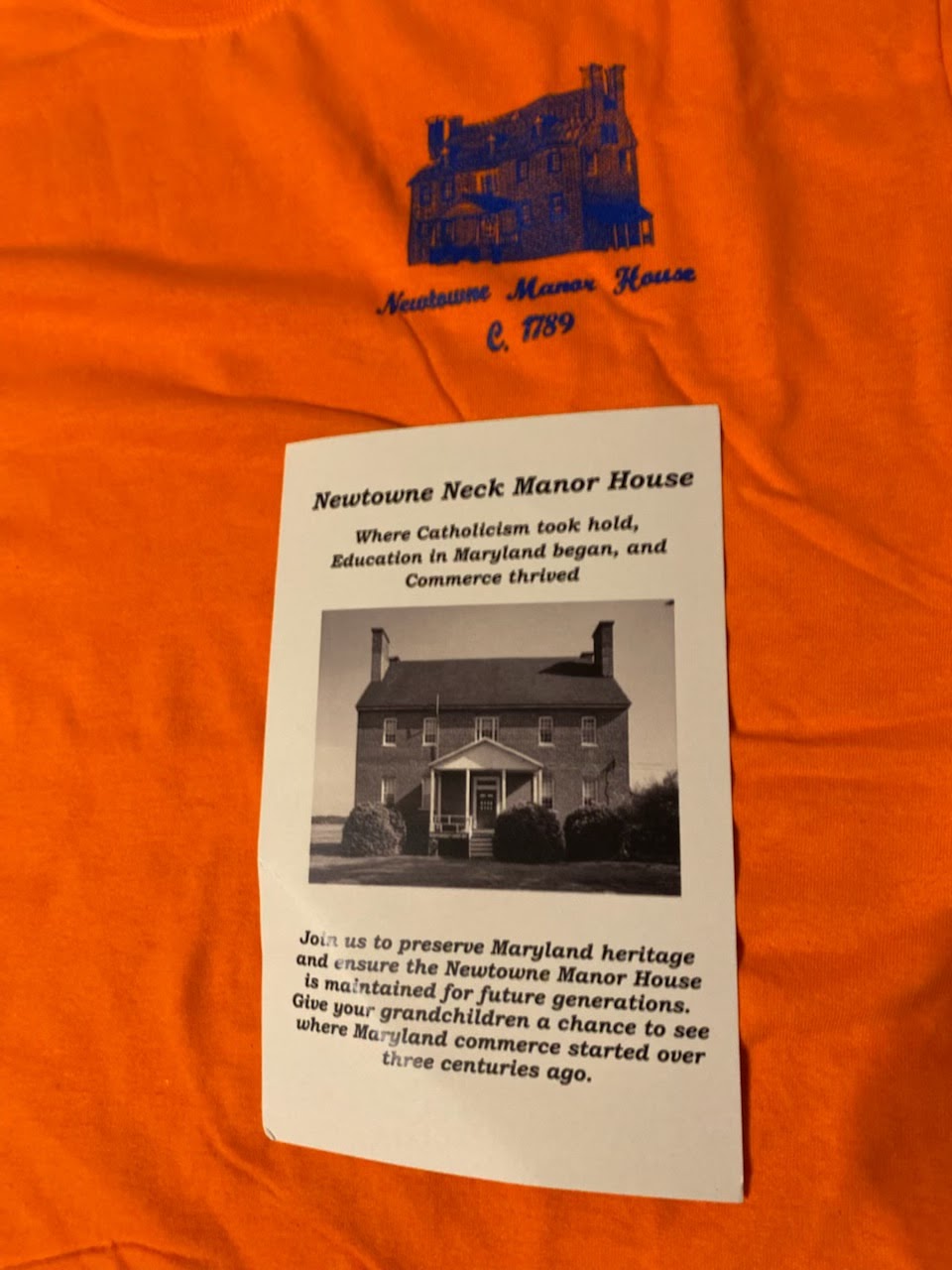
Parishioners provided lunch that was perfect: chicken salad with rolls, homemade sliced pickles, corn chops, cookies, and banana nut bread.  AC in the community center felt great after a very hot morning.  The parishioners also gave us t-shirts and a Newtowne Manor brochure.


Friday, July 22: Ned volunteered half a day -sawing tree roots.

Thursday, July 21: Ned volunteered for the day - digging and sifting.

Wednesday, July 20: Ned volunteered for the day.   There were four other volunteers.  One of the volunteers is involved in the Georgetown slavery project.  Ned continued work on the fifth unit (referred to as the Neapolitan Sandbox) until they hit subsoil at around 22".  This unit has had the most artifacts recovered. The plans are to backfill three or more units on Thursday and to concentrate on the two units opened on Tuesday.  They will be finishing up in the units on Friday with final cleanup being Saturday.

Tuesday, July 19: Carol and Ned volunteered.   Work continued on the fourth and fifth units.  Nine students and their teachers from Loyola University volunteered on the site.  This was the first time that many of them had been in the field, and some of them helped at the two open units.  Two new units were opened by the students including one where a fence line was shown on the GPR map.  The most interesting find was the the upper torso of a Frozen Charlotte doll found in the unit where Ned was working.  And Ned's unit also had metal objects, one of which Ned identified as being used to mend a broken plowshare.
The day started with a short trip and a tour of the site of the seventeenth century Saint Francis Xavier Chapel and the cemetery.  On returning Sara, a member of the Newtown Manor House Committee, gave us a tour of the first floor of the Manor House as well as providing lots of history about the house.

Saturday July 16: Carol volunteered for the day.  There were only four volunteers so we only worked on two of the units.  By the end of the day all the sand layer had been removed from the "sand" unit.   Work also continued on the fourth unit with the building rubble - first to document it and then to excavate two features. 
Late in the day three more units were put in.  Laura determined the GPS location of each unit using a real-time kinematic (RTK) GPS instrument that consisted of a fixed base station and a rover that communicated with multiple satellites and then the resulting location data is transferred to an app on Laura's phone.  Laura had already identified the location for each of the units, and the rover was moved until it was on the exact coordinates of the northeast corner.  Then the rover was moved south about five feet and moved until it was over the exact southeast corner coordinates on Laura's map.

Friday, July 15: Carol and Ned volunteered.  The second unit with all the oyster shells yielded eighteenth century artifacts.  Nothing much to report on fourth unit where there was a row of brick rubble except that Carol really enjoyed spending most of the afternoon troweling.  Ned got to open a fifth unit on the east of the Manor House.  The GPR showed an interesting pattern that turned out to be almost a foot of sand fill.  It was a beautiful day to be outside. Here are a few photos.

 
Thursday, July 14: Ned volunteered for the day.  Jim was also there.  The top level of the third unit was removed to show lots of oyster shell.  This unit is believed to be over a cellar.  Another unit was opened where a previous building had been excavated and possibly later identified with a brick outline, but there is no documentation to indicate what was found.  There are always questions to answer, and Laura had one for this unit and that question determined the exact part of the building on which to place the unit. 

Wednesday, July 13: Ned volunteered, and here is his update and photos for the day.
The day was very strenuous but also a fun day.  Dr Masur is great.  Her crew of mostly doctoral candidates are a fun bunch. We almost finished two test units and removed sod from a third.  The one with the "pope" might have a corner of a foundation.  
The second unit was placed where GPR showed a large rectangular object near the building turned out to be a large flat stone that was outside the building.  (On well, another STP will be needed to investigate the building.)


The other two sites already investigated were Old Bohemia Wildlife Management Area, Cecil County, Maryland and Webster Field Annex, St. Mary’s County, Maryland

July 15, 2022

CCASM T-Shirts and Hats

The shirts and hats are here!  And they look great.

Earlier this year CCASM members had an opportunity to purchase a T-shirt or sweatshirt with the CCASM logo on the from.  Joe volunteered to work with the vendor for the entire process of making the shirts (and the hats), and Elsie "volunteered" to compile the orders.  Thirteen of our members ordered t-shirts and/or sweatshirts.  

Members could also order hats and six members did.


Now when CCASM members volunteer in the field or participate other activities, they can let others know that we are there and that we are supporting archaeology.  

A very special thanks to Joe for making this happen. 
As always, thanks to Elsie, CCASM treasurer, for keeping track of the orders and money.


June 28, 2022

2022 Public Archaeology Lab Days (Feb-Jun)

CCASM has been working with Charles County at the ongoing Public Archaeology Lab for a number of years.  The lab is for processing artifacts recovered from various archaeology initiatives in Charles County -  including processing artifacts recovered from savage archaeology in the County as well as those recovered in the 1970's around the Port Tobacco Courthouse.  Esther Read is the archaeologist in charge.

Cataloging Artifacts

On June 27 weather prevented us from being in the field at Maxwell Hall Equestrian Park.  So Linda, Denise, Claudia, Peggy, and Carol got to continue cataloging the Port Tobacco BF1 artifacts upstairs at the Courthouse.  It was the first time for Claudia and Peggy to help catalog, and they got to help catalog bones.  We didn't pick an artifact of the day, but here is a photo of Linda cataloging some small artifacts.

It seems June was the month for taking vacations and doing other things.  Even so Denise, Claudia. Peggy, and Linda joined Esther in the lab at Burch House on June 13.  Sorry we didn't pick an artifact of the day.

Fire Cracked Rock
On June 6 Claudia, Denise, Mary, Kathy, Malinda, Peggy, and Carol all worked outside Burch House on the picnic tables.  We sorted and bagged artifacts - some from the 1970 excavations and some from the STPs we had dug on May 9 north of the Port Tobacco Courthouse.  The artifact for the day came from the later and was a fire cracked rock.  Native Americans heated stones and put them in vessels containing liquids in order to heat up the liquids.  The heating and cooling of the stones could cause them to crack.  Thus fire cracked rocks indicate Native Americans were in the area.


On May 23 once again we split up.  On the picnic tables outside Burch House Malinda and Kathy continued to wash the artifacts from the STPs.  Inside Burch House Claudia and Elsie sorted and bagged - Claudia working on the STP artifacts while Else worked on the artifacts we had washed at PT Market Day.  While over at the Courthouse, Linda and Carol continued cataloging the BF1 artifacts, and they chose the artifact of the day.  They chose this piece of sprig molding from a stoneware vessel.  We just happened to have Sherry and Hood's book Salt-Glazed Stoneware in Early America in the lab, and the sprig fragment looked like part of the crown in a photo of a Westerwald "GR" stoneware jug.

Sprig Molding
Photo excerpt: Sherry and Hood,
Salt-Glazed Stoneware in Early America

On May 16 Elsie, Malinda, Mary, Peggy, and Carol washed most of the artifacts recovered from the STPs dug on the previous Monday.  The majority of the artifacts were brick fragments, but we did recover this one unusual artifact that we decided to post as the artifact of the day in hopes someone might be able to identify it.  It is tube-like and mostly metal with pieces of rubber coming out one end.  While the others were washing, Linda dry brushed any nails or metal objects as well as some mortar.  She also tackled a bag of rusty metal artifacts recovered around 1970 that had been in the lab for months just waiting to be processed.  We ended up stopping early in anticipation of bad weather.

Two-tine Fork with Bone Handle

On May 2 we returned to the lab.  In the morning Elsie, Linda, Malinda, Kathy, and Claudia continued sorting and bagging artifacts at Burch House. Elsie and Denise brought down some more artifacts from the Courthouse attic. Carol joined them in stabilizing these artifacts.  After years in the attic plastic bags tend to fall apart, and it is important to put the contents in newer bags until the artifacts can be processed.  It's from these artifacts that we found the artifact of the day - a two-tine fork with a bone handle.  And it still had it provenience - Area B, Feature 1, Unit 2, Level 4. (Note: this is one level above April 18's toothbrush.)
In the afternoon we all joined Esther to check out the area north of the Courthouse and look at what had and had not been investigated.

Bone Toothbrush
Fragments (top /bottom)
On April 18 Polly, a visitor, joined Malinda, Kathy, and Mary as they all sorted and bagged artifacts at Burch House while Linda, Denise, and Carol cataloged artifacts at the Courthouse.  This is the first day that we used all three cataloging computers.  We chose these fragments from the head of a bone toothbrush that had been recovered from BF1, Unit2, Level 5 as the artifact of the day.  The two pieces on the left show the holes on the top where the bristles would have been.  The two pieces on the right show the slits on the back for the wire that was used to pull the bristles into the holes.  For a better idea of what the toothbrush would have looked like, visit JPPM's Diagnostic web page https://apps.jefpat.maryland.gov/diagnostic/SmallFinds/Toothbrushes/index-BoneHandledToothbrushes.html .

Wine Bottle Finishes
with String Rims

April 11 was somewhat of a slow day.  Denise, Linda, and Carol catalogued Port Tobacco artifacts.  We chose these three bottle finishes with string rims as the "artifact of the day".  These are from wine bottles made in the early eighteenth century, but the three different string rims (flat, v-tooled, rounded) are associated with different manufacture dates. They were found in a large bag of patinated olive green bottle fragments recovered from BF1, Unit 5, Level 5.

On Monday April 4 a proposed day in the field had to be postponed.  At the Courthouse Denise and Carol organized and also catalogued artifacts while Peggy connected the printer to two computers after loading the printer driver.  Elsie and Claudia continued sorting and bagging artifacts at Burch House, and they came up with several artifacts to be the artifact of the day.  We decided to chose two that were made centuries apart.  One is a Staffordshire-Type Slipware rim fragment from the early eighteenth century while the other is part of the base of  a cup with a pressed glass pattern probably from the late nineteenth century.  Thanks to Claudia for the photos.

Staffodshire-Type Slipware
Pressed Glass Pattern

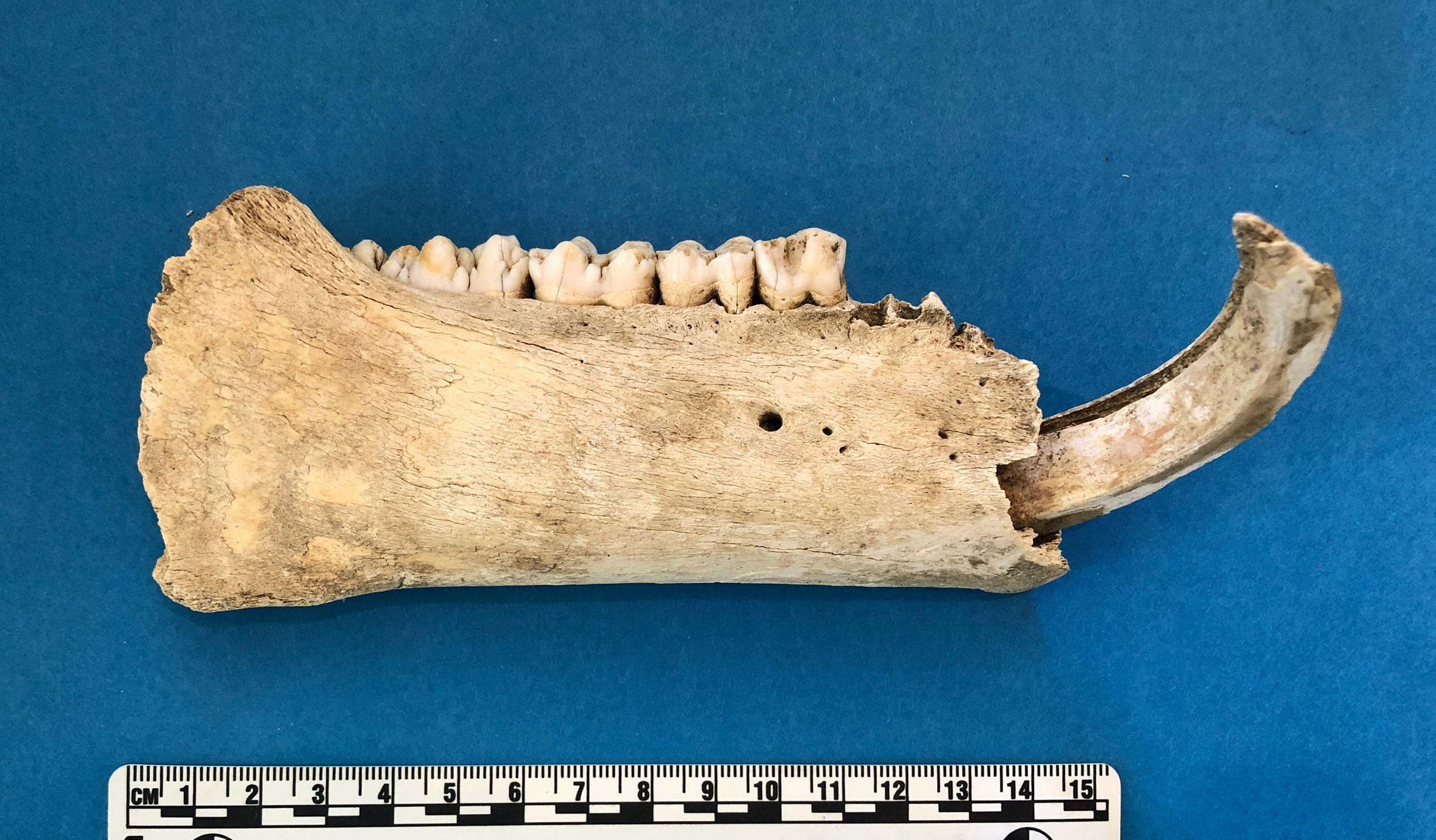
Monday March 28 was a busy day.  Elsie, Claudia, Malinda, and Kathy were at Burch House sorting and bagging the artifacts in the drying screens.  The previous week they had filled all the screens so the screens had to be cleared before more artifacts could be washed.  Denise, Linda, Mary, Peggy, and Carol were upstairs at the Courthouse.  Denise and Linda continued trying to organize the non-BF artifacts.  All the different designations are a little confusing.  Peggy worked on connecting and checking out two of the workstations while Mary and Carol catalogued artifacts.  We came up with a couple of possible artifacts of the day but ended up choosing this pig mandible fragment that still had almost all of its teeth as well as its tusk.

Pig Mandible with Teeth

Monday March 21 Peggy, Claudia, Malinda, and Kathy washed or dry brushed artifacts at Burch House while Elsie bagged artifacts that had been washed the previous week.  Meanwhile at the Courthouse Linda and Denise sorted boxes and artifacts in preparation for cataloging them.  Claudia came up with  a number of possible artifacts of the day, but we selected this printing block.  Unfortunately we didn't have as much luck trying to read it as we did for the block we found last August.  Even so, it is interesting.  It appears to be a legal notice.

Printing Block
Mirror Image of Printing Block
Discernible Letters

Also in the afternoon Malinda, Elsie, and Esther started doing a deed search on Malinda's property where last Wednesday they had located a previously unrecorded cemetery.
(Thanks to Elsie for the info and Claudia for the photo.)

On Monday March 14 the lab started getting back to normal.  Peggy, Mary, Malinda, and Ned were joined by Kathy (Visiting from DC) to wash Port Tobacco artifacts at Burch House.  Everyone really liked the new drying screens were.  (The screens had been built by Doug, also a CCASM member.)  Back at the Courthouse Linda, Denise, and Carol tried to set up three computer stations.  There was a lot of trouble with one station until Esther took off the cover (and jiggled a video board).  In the afternoon Denise, Ned, Linda, and Carol once again started cataloging again.  Sorry no artifact of the day. 
(Thanks to Elsie for photo of screens.)

New drying screens being used for the first time

The lab on Monday March 7 was a little different.  Not only had it been several months since we had cataloged Port Tobacco artifacts, the lab had been moved about so the ceiling could be painted.  So Elsie, Denise, Linda, Ned, Claudia, and Malinda checked on the artifacts that needed cataloging, set up computers, and tried to make sense of it all.  Also the lab had a belated pot luck holiday party with Esther bringing pizza and everyone else contributing deserts, salads, drinks, etc.

On Monday February 28 the Charles County Lab started up again.  The lab had been on hiatus for a couple of months while CCASM members and other volunteers processed artifacts for a special ASM project.  Although we were ready to return to processing Port Tobacco artifacts. on this first day we were not in the lab but outside.  It was a nice day to be outside.  Elsie, Mary, Denise, Ned, Peggy, Claudia, Carol, and Malinda (a new volunteer) joined Esther Read to check out the land along the Port Tobacco Creek where there had once been a canal.  Esther was checking out the area for the possibility of Charles County creating a walking path there.  While we were walking, Linda was holding down the lab back at the Courthouse.

Clearing the Way
Walking along the Berm

2021 Public Archaeology Lab Days (Mar-Dec)
2020 Public Archaeology Lab Days (Sep-Dec)
2020 Public Archaeology Lab Days (Jan-Mar)
2019 Public Archaeology Lab Days (Jul-Dec)
2019 Public Archaeology Lab Days (Jan-June)
2018 Public Archaeology Lab Days (July-Dec)
2018 Public Archaeology Lab Days (Jan-June)
2017 Public Archaeology Lab Days (July-Dec)
2017 Public Archaeology Lab Days (Jan-June)
2016 Public Archaeology Lab Days (July-Dec)
2016 Public Archaeology Lab Days (Jan-June)
2015 Public Archaeology Lab Days