September 17, 2023

Investigating the James Swann Site -2023

CCASM and other Monday volunteers are working with Esther Read to continue the investigation of the James Swann Site that is now owned by Charles County.  James Swann was a "free man of color" that acquired land in Port Tobacco in 1840's and operated a tavern and oyster house in the village for almost twenty-five years. 

Check Public Archaeology Lab Days post for weekday schedule

At the Public Archaeology event on Sunday September 17 CCASM members Linda, Mary, Denise, Elsie,  Carol, Ned, and Steve were joined by Kim and Greg to continue investigating the Swann Site.  This was Kim's third time to attend one of the Public Archaeology days.  We worked on closing out levels and opening new ones in the existing units as well as excavating some features, but we didn't find an artifact of the day.

Working in Units 5 and 6
The Screeners
 
Polychrome Rim
At the Public Archaeology event on Saturday September 16 six CCASM members -- Linda, Denise, Elsie, Carol, Ned, and Steve -- were once again joined by Susanna, Alix, Leah, Alana, and Ben to help Esther continue to investigate the Swann Site.  Doug and Linda had cut the grass in the area where the units were, and Ned had removed some of the weeds.  So the site was nice and the weather was nice.  Francis Jamieson whose family had owned the property stopped by to reminisce with Esther.  Dorothea Smith also stopped by.

Toward the end of day we found an artifact (actually two pieces that would mend) that we choose to highlight as the artifact of the day.  It appears to be a saucer rim with polychrome painted decoration.  According to the JPPM Diagnostic Artifacts in Maryland web page, these colors were used c.1795 to c.1815.

Units 5 and 6 in Field
with other units in background
Units near Fireplace

Screening
Drawing Wall Profiles
End of Day

Thanks to Ned for providing additional photos.

On Monday September 11 four people-- Claudia, Elsie, Carol, and Ned --joined Esther in the field at the Swann Site while others worked in the lab at Burch House.  We worked on completing Level 1 of Unit 6, and Ned also did some yard work.  This was in preparation for the upcoming Public Archaeology Weekend.
Finding Artifacts

Monday August 14 four people worked in the field at the Swann Site while others worked in the lab at Burch House.  Esther continued working on the newest unit and lowered the level to the start of a soil change (orange subsoil).  Denise and Mary sifted the soil while Ned scooped soil and carried buckets to the screen.  Several tiny pieces of blue tin-glazed earthenware were recovered.
Thanks to Ned for info.

On the weekend of July 22-23 there was another Public Archaeology event at the Swann Site.  Since it was in the high 80’s, we started around 10 and stopped early.  On Sunday June 25 CCASM members Elsie, Carol, Ned, and Steve, along with experienced volunteers Tim and Claudia, and Kathy, an actual archaeologist, continued to work on the site.  Steve and Kathy concentrated on the units inside the foundation.  Elsie and Ned with a little help from Esther worked on the new unit.  Carol finished excavating the feature in the unit about 12’ south of the building.  Tim and Claudia were kept busy screening soil.

Inside Foundation
Sunday Volunteers
Where there's a will

On Saturday July 22 CCASM members Linda, Elsie, Denise, Ned, Steve, and Doug along with experienced volunteer Tim worked with five new volunteers – Greg, Kim, Susanna, Alix, and Leah.  A new 3’x3’ unit was opened up in the field next to Unit 4.   Steve continued to work inside the foundation in the chimney pent.  There was plenty of soil that needed screening to keep all the volunteers busy.  Esther who was on crutches supervised.

New Unit
Saturday Volunteers

Thanks to Ned and Esther for the additional photo.

The weekend  of June 24-25 was the occasion for Public Archaeology event at the Swann Site.  On Sunday June 25 we started a little later in the day.  Before lunch Elsie and Denise continued to excavate Unit 5 while Carol finished documenting Feature 1 (Unit 3) and stared excavating Feature 2 (Unit 4).  Near lunch and in the afternoon there were a number of visitors.  So Esther and the three of us talked about the site, James Swann, and archaeology, and the visitors shared information with us -- what public archeology is all about.   Here are photos of some of those that dropped by.  (Sorry no artifact of the day.)

These visitors spent a lot of time on site
(shown with Denise and Elsie)
Esther talking with visitors

Possible Point Base and
Historic Transfer Printed
Ceramic

On Saturday June 24's Public Archaeology day rain was predicted.  It was overcast in the morning, but the sun came out.  Seven people came out to help Esther - CCASM members Linda, Elsie, Denise, and Carol plus Tiara who has volunteered with us before and two people who learned about the site through the the Charles County Citizens Academy - Tamara and Kim.  Dorothea Smith also dropped by in the morning to visit the site.  We continued digging Unit 5.  We still aren't sure what's happening there.  Carol and Tiara also excavated and documented Feature 1 that appears to be a post hole.  

Once again we chose a Native American and a historic ceramics - both from Unit 5 - as the artifact of the day.  On the left is what appears to the the base of a quartzite projectile point (Native American).  It is shiny because we washed off the dirt to see it better.  On the right is a piece of transfer printed ceramics (historic).  

Learning to identify what to keep and
what is just a rock
Excavating a Feature

Thanks to Esther for the additional photo.

Point Tip and
Historic Transfer Printed Rim

 On Monday June 19, Juneteenth, we opened a new Unit--Unit 5.  A few volunteers concentrated on digging, more concentrated on screening, and others floated back and forth.  In addition to Esther nine people were there -- CCASM members Ned, Linda, Elsie, Mary, Denise, Kathy, and Carol as well as volunteers Claudia and Malina.  It was fairly hot so we had a shade for the diggers.  The screeners were in the trees and there was often a breeze. 

We were finding both Native American and historic artifacts and decided to choose these two very small artifacts from different cultures as the artifact of the day.  On the left is a piece of worked jasper that appears to be the snapped off tip of a projectile point (Native American).   On the right is a transfer printed plate rim (historic).  Both were found in the plow zone of Unit 5.

For those screening, we had a surprise.  Doug, a CCASM member that likes to invent and build things, had made a screen where the sifting tray was on wheels.  It was really nice to use.  Although we have borrowed screens in the past where the trays were on wheels, now we might not need to.  Also Doug's screen can fold up. 

Digging Unit 5 under shade
  
Screening with new screen
and older one
Folding up new screen
for storage

Worked Quartzite
Monday June 12's air quality was better than previous days but still only moderate. In the morning Esther started early to continue the excavation of Unit 4 at the Swann Site, and Ned helped.   Mary, Linda, and Carol screened while Denise and Claudia worked in the lab. After lunch Mary and Linda joined Denise and Claudia in the lab while Ned and Esther returned to the site. Ned cleared undergrowth in the small clump of trees. (He returned on Tuesday to finish the clearing.) Esther cleaned up the unit and did paperwork.

We chose this worked quartzite tool (scraper?) recovered from Unit 4 as the artifact of the day. It is a reminder that Native Americans were on this site before there was a Port Tobacco.
Thanks to Denise for the additional info.


Streaky Glass
Fragment
Monday June 5 was another great day for being outside, and we were quite busy.  Esther brought out her transit.  Elsie and Malinda worked with her to lay out a large grid south of the Swann House.  Steve, James, and Emily, a new volunteer, used metal detectors to check out several areas.  The grid will be used to record The number of metal detector hits in each square as well as what was found in each square will be recorded.  This will allow us to determine location that need additional investigation (i.e. units).

Carol, Linda, Peggy, and Mary put in a new 3'x3' unit (Unit 4) north of the existing one.  Ned got to shovel the plowzone while Linda, Peggy, Mary, and Carol screened.  At the end of the day we found this small fragment of colorful streaky(?) glass that may be from the late nineteenth century.  It was the most unusual thing we had found.  So we chose it as our artifact of the day.

A little of everything
Taking a break from screening
Laying out Grid
Thanks to Ned for all the photos he spent.

Shell Button
Monday May 15 was a great day to be outside.  CCASM members Densie, Elsie,  Linda, Pat, Carol, and Steve were joined by Claudia, Malinda, and James to continue excavating the site. Denise, Malinda, and later Carol excavated the "school" test unit down to subsoil and only uncovered a possible fence trench.  Esther finished cleaning up the unit.  Steve and James continued to remove the fill dirt near the fireplace.  Esther swept off the floor in the unit near the fireplace.  There was a wall extending out from the fireplace base and you can see a brick floor . Most of the screening was done by Elsie, Linda, Pat, and Claudia, but eventually everyone ended up screening.   And we chose this small shell button found late in the day in the fill dirt as the artifact of the day.


Wall and floor in Unit that
extends outward from Fireplace
Screening

Possible Fence Trench
in "School" Unit

Saturday May 6 Port Tobacco Market Day included Public Archaeology at the Swann House Site. CCASM members Mary, Elsie, and Steve along with four UMBC students assisted the public at the site while Esther Read told the story of James Swann and the site, but also talked about archaeology. We were investigating a 3'x5' unit in the "chimney fall" area that keeps getting stranger and stranger. Work continued on the unit after Market Day ended with Ned and Pat joining the other CCASM members already volunteering on the site.

Wednesday April 26 CCASM member Elsie with Ned, Steve, and James stopping by for various periods worked with Esther to extend the 3’x3’ unit up to the fireplace foundation so it became a 3’x5’.  Very slow going.  Huge amount of brick rubble (might be a chimney fall). Some ceramics, cut nails (maybe 1 wrought nail). Got around 100 lbs brick out of the unit and over 60 lbs from the extension.

Thanks to Elsie for the info and to Elsie and Esther the photos.

Monday April 24 CCASM members Denise, Elsie, Linda, and Mary along with Claudia worked with Esther to open a 3’x3’ unit about 2 feet in front of the fireplace foundation.  Ned stopped by briefly to help.
Thanks to Elsie for the info

Monday April 17 was a busy day. CCASM members Denise, Doug, Elsie, Linda, Mary, Ned, Pat, Peggy, Steve, and Carol were joined by Claudia to complete the clearing and flagging of the site before a planned visit by school children on Wednesday.  All the remaining  leaves, vines, etc. were removed and placed in the brush pile. When the site was closed in 2009, black plastic was placed over the exposed fireplace bricks, and then dirt and bricks were placed on the plastic.  We removed and sifted the dirt over the plastic and removed the plastic to expose that end of the house.  Although we expected the dirt to be sterile, we found various ceramic and glass fragments including fragments of Rockingham earthenware and brown stoneware.  At the end of the day, Doug removed any loose dirt on the stones.

Clearing Site near beginning of day
 
Cleared and flagged Site at end of day.
The exposed fireplace bricks are on the left.

On Wednesday April 12 Esther and CCASM members Ned, Doug, Linda, Elsie, and Carol continued clearing the area around the site - removing trees, undergrowth, and vines hanging from trees.  Ned used his chain saw while the rest lopped or clipped and then drug cut debris to the brush piles.

Cutting
Adding to brush pile

On Wednesday April 5 Esther and CCASM members Steve and Ned worked on clearing the Swann site. Steve found one of Jim’s datum points at a corner of the foundation using his metal detector.  Steve cleared the short ends of the foundation including Jim’s test unit.  Ned mostly used a chainsaw to cut trees and larger limbs and to cut sharp stubs flush.   Esther did lopping and clearing.   It was in the low 80s.   We will get additional information when Jim inspects the site on Sunday. 

Looking for metal clues
Clearing area

Thanks to Ned for the info and photos. (These are only two of the many photos Ned took.)

On Monday April 3, instead of being in lab, CCASM members Denise, Linda, Doug, Elsie, Ned, Mary, and Carol along with volunteer Malinda were at the Swann House site clearing off the site.  Elsie and Ned had brought nippers and loppers, and Doug brought a chain saw.  The rest of us piled up debris for the County to haul away. 
Using documentation from Gibb's reports, Carol and Elsie identified the area containing the foundation.  This area was easier to clear (mainly briars) except for the several large fallen tree branches.   

Starting to Clear

  
Area over Foundation
partially cleared
The whole crew at end of day


 Background: On May 20, 1846 the heirs of William Graham conveyed to James Swann, ”a man of color”, one lot (probably Lot #1) and half of another lot (Lot #4), both lying in the town of Port Tobacco on what was commonly called the “Point”.  The lots were already in the possession of James Swann in 1843.  James Swann operated an inn and oyster house in the village for almost twenty-five years. 

Swan House
Foundation


In 2009 as part of a Preserve America grant Dr Jim Gibb and his crew as well as future CCASM members (CCASM had not been incorporated yet) cleared the site and identified the foundation of a building believed to be the Swann House. After documenting what was found, the site was back filled. 

June 24, 2023

"Finding Charles County" Blog

Esther Doyle Read has created a new blog called FINDING CHARLES COUNTY, A Journey Through the Archaeology and History of Charles County, Md.  

The blog will highlight some of the projects Esther, CCASM members, UMBC students, and other volunteers have worked on or are currently working on in Charles County.   She plans to weave information from the field work, historical documents, and when possible oral histories to tell stories about Charles County.

Esther who is an archaeologist and a professor at UMBC is also a member of CCASM.

For future reference, you can find the link to Esther's blog on this blog's Archeology Links Page.

June 18, 2023

2023 Public Archaeology Lab Days (Jan-June)

CCASM has been working with Charles County at the ongoing Public Archaeology Lab for a number of years.  The lab is for processing artifacts recovered from various archaeology initiatives in Charles County -  including processing artifacts recovered from savage archaeology in the County as well as those recovered in the 1970's around the Port Tobacco Courthouse.  Esther Read is the archaeologist in charge.

Starting Monday April 3 we were in the field at the James Swann Site unless it is raining or ... 
see  Investigating James Swann Site

Cleve & Steve bottle fragment
On May 22 CCASM members Linda, Elsie, Peggy, Kathy, and Carol were joined by Malinda to finish washing artifacts from the blacksmith site "bottle dump" and to continue washing the artifacts being recovered from the Swann Site. Actually Peggy brushed, rahter than washed, any metal artifacts we found in the bags.
We chose this amber colored bottle fragment as the artifact of the day.  The fragment was embossed with the letters "CLEVE & ...  / NOVEMBER 8TH 92 / MARCH 4TH 93".  There was another another amber colored bottle fragment with a rooster on it.  It turns out they were part of the same bottle.  During Grover Cleveland's 1892 Presidential campaign, amber barrel half-pint and pint flasks were produced to promote Cleveland (Cleve) and Adlai E. Stevenson (Steve).  The rooster was the symbol for the Democratic Party in some Midwestern states.  These bottle fragments were found in the North Port Tobacco blacksmith "bottle dump".

Sontag & Sons cup
In the morning of May 8, while the others were helping with a school group tour, Mary, Denise, and Claudia worked in the lab at Burch House.  After lunch they were joined by Elsie, Linda, Malinda, Carol, and Esther.  Some worked on the Maxwell Hall artifact bags.  Others worked on washing artifacts from the barrel found in the fireplace area of the Swann Site.  And the rest worked on washing artifacts from the "bottle dump" at the blacksmith site.  These latter two sites are both in Port Tobacco.
We chose these porcelain cup sherds from the blacksmith site "bottle dump" as the artifact for the day.  The maker's marlfound on the bottom of the cup was used by the Sontag & Sons porcelain factory from 1887 to 1902.  The factory was in Tettau, Bavaria, Germany.


Bottom Tool for
Anvil Hardy Hole
 
Similar Bottom Tools
as well as Top Tools
On May 1 the Swann Site was too muddy for us to dig.  Before lab CCASM members Linda, Elsie, Ned, and Denise assisted Esther with visits by an elementary school group.  Later at Burch House CCASM members Mary, Linda, and Denise were joined by Claudia to wash, sort, and bag the last of the artifacts from Maxwell Hall.  Other CCASM members Peggy, Ned, and Elsie were outside brushing rust off of metal artifacts from the Port Tobacco North blacksmith site.  After lunch Ned and Esther bailed out the water in the Swann units and may have added more black plastic to keep some other parts of the site dry for this weekend. 

And once again the artifact of the day came from the blacksmith site. It is a bottom tool that inserts into the square hardy hole in an anvil.  It is often used with a handled and matching top tool to shape tenons to a round shape.  It could still be used after light cleaning.  Ned provided a photo of two similar bottom tools that fit in the square hardy hole of anvils plus a top tool without handle and one that has a handle.

Esther had met with those in the Citizens Academy to get their input in how to better interpret, advertise, and show Black sites, cemeteries, and artifacts. She presented their suggestions to the CCASM volunteers during lunch at Burch House.

Thanks to Ned and Else for info (merged) and to Ned for photos.

Brass Object
March 27 we were once again at Burch House.  Ned, Elsie, and Denise (in the morning) worked outside removing what rust they could from the Port Tobacco North artifacts.  And among all the rusty artifacts they found the artifact of the day - this unidentified brass object.  It looks like there may have been a belt used to turn something that is now broken off.

Inside Linda, Claudia, Carol, and later Denise and Elsie worked on finishing up the washing of the artifacts recovered from around the Maxwell Hall House and started on sorting and bagging of the artifacts in the screen.  

Sorting using new
Light Stand

 
For those of you who have been to Burch House you will know that our lab room has one small window, no overhead lights, and just a couple of desk lights.  So sometimes sorting is a little difficult.  Now thanks to the light stand that Doug, one of our members, made that is no longer the case for at least one work station.  Doug also made the drying screen in the picture. 


March 20 while most of the volunteers were in the field at Maxwell Hall Equestrian Park, Linda and Claudia were in the lab washing oyster shells recovered from in front of Maxwell Hall (the house).

On March 13, a dreary Monday, we stayed inside and took inventory.  Ned and Peggy inventoried shovels and other field supplies that were kept in the Stagg Hall storage building. 

Embossed Glass Bottle Sherds
Linda and Claudia inventoried bags and lab supplies at Burch House.  Afterwards they started sorting and bagging the North Port Tobacco artifacts with the benefit of the better lighting in Burch House. Our lab has only one small window.  A simple fix was to upgrade the bulbs in the lamps to led ones.  A better fix was when Doug brought us a stand he had built to hold another light we had.  This really allowed us to see the artifacts in the tray. 
We choose these two pre-WWI glass bottle sherds as the artifact of the day.  One is embossed with "PATENTED" and "SEP ..... II".  The other is embossed with "SEPT.19.& NO".

Mary and Carol inventoried bags, cataloging supplies, and miscellaneous items in the lab area on the second floor of the PT Courthouse.  Interestingly there is a carriage with Sarven Patent hubs on the  second floor.  Ned was able to identify our unidentified Feb 28 artifact as part of a carriage fifth wheel.

Part of Fifth Wheel
Carriage

Although Esther was in the field at Maxwell Hall on Monday March 6, the lab was open.  Linda, Mary, Peggy, and Carol were joined by Danielle, an ASM Certified Archaeological Technician (CAT) program candidate.  One of the requirements to earn the CAT certificate is to volunteer at least 40 hrs in the lab, and Danielle is volunteering at various labs around the state.  It was another beautiful day to work outside.  We continued processing rusty iron artifacts, and we were able to finish washing the last of the artifacts recovered from over the forge at the North Port Tobacco Site.  Interestingly among all the shells and artifacts from the late 19th and early 20th centuries, we found fragments of a tin-glazed cup that was manufactured much earlier - before mid-eighteenth century.  There were four sherds with the larger one having the cup shape, and there were five pieces of glaze.  An ointment jar would also have that shape. We chose these sherds as the artifact of the day.

Tin-glazed sherds
and tin glaze fragments
Processing artifacts outside


Possible Lever
or Hopper Part

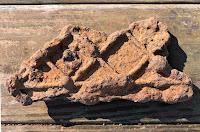
On Monday February 27 the lab was full.  Ron, a new volunteer,  joined Malinda, Kathy, Linda, and Carol washing and/or dry brushing artifacts inside Burch House.  Also inside Denise and Mary sorted and bagged the washed artifacts.  Elsie and Claudia worked outside brushing dirt and rust off of the metal artifacts.  Ned and Peggy joined them outside later in the afternoon.  Once again we choose a rusty artifact for the artifact of the day.  We aren't sure what it is.  We think it may be part of a lever, although a Facebook comment indicated it might be part of a hopper that is used to distribute seed.


On Monday February 13 Linda and Mary volunteered in the lab rather than being in the field at Maxwell Hall.  Linda cleaned oyster shells and glass while Mary sorted and bagged artifacts, mostly glass, that had been washed the previous week.  We didn't come up with an artifact of the day.  Maybe next time.
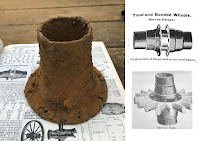
 
Sarven Patent Hub
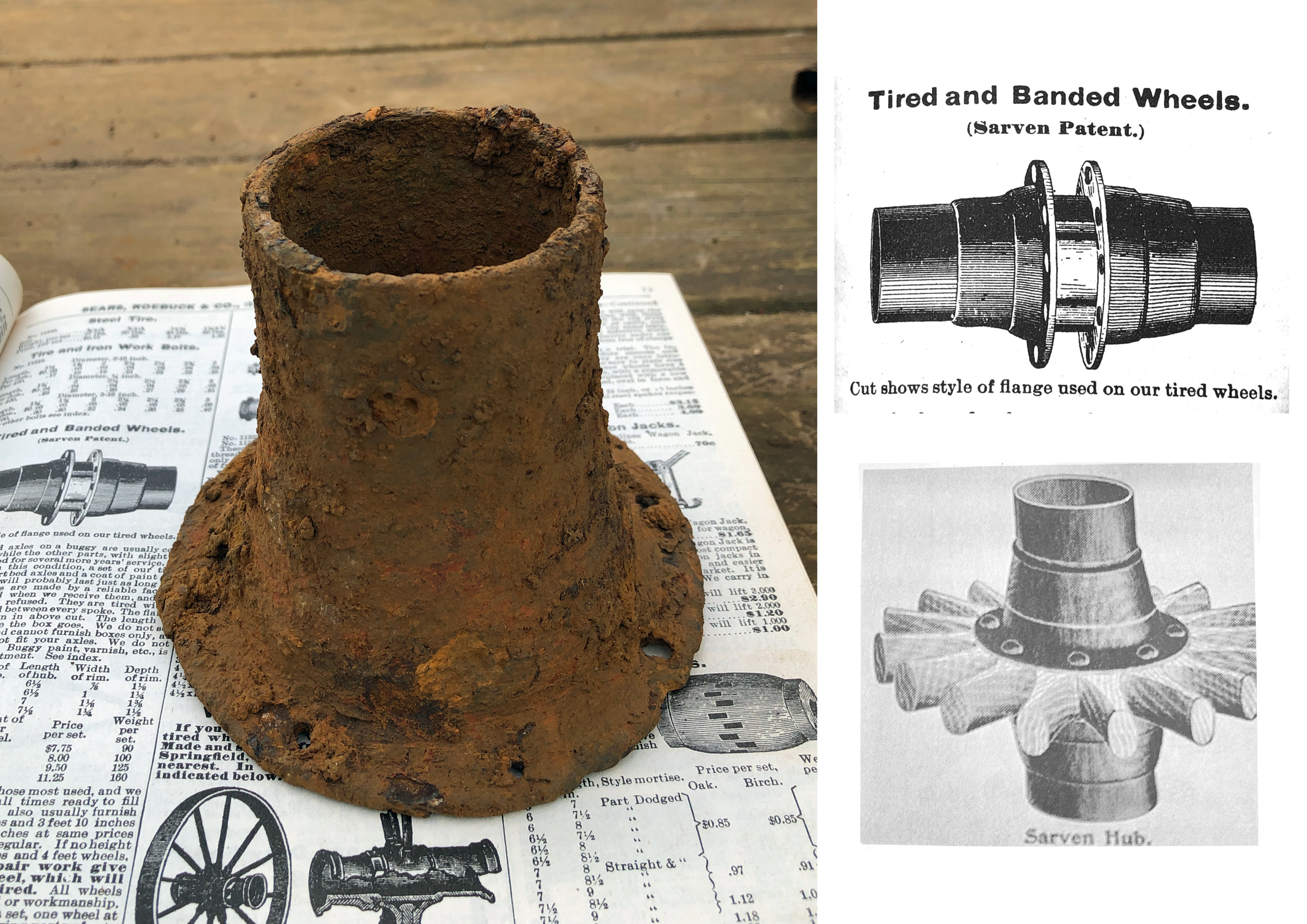
Although Monday February 6 was overcast, it was still a good day for the Lab to be outdoors.  Ned, Elsie, Peggy, and Claudia worked outdoors  behind Burch House with some brushing off dirt and rust off artifacts and others brushing oyster shells or washing artifacts.  Denise, Malinda, and later Carol worked inside sorting and bagging any dried artifacts or else washing some of the really dirty artifacts.  All these artifacts were from the North Port Tobacco site.  Once again we chose one of the artifacts that Ned had identified as the artifact of the day.  The artifact of the day was this Sarven Patent Hub.

 
Shaft Coupling
Monday January 30 was one of those days that it's great to be outdoors - sunny and not too cold.  So we held the lab outdoors at Burch House and worked on artifacts recovered from the North Port Tobacco site.   Claudia brushed dirt off oyster shells while Peggy wash the other. non-metal artifacts.  Denise, Elsie, Ned, and Carol  brushed dirt and some rust from artifacts in one of the buckets.  We chose this carriage shaft coupling as the artifact of the day.  Ned identified it from an old Sears Roebuck Catalog.
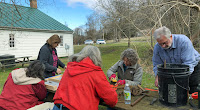
Removing dirt from artifacts


Lots of food

Instead of lab on January 23 we had a party - a belated Christmas Party.   Esther brought the pizzas, and everyone else brought pot luck dishes.  Lots of food and a nice time to be together.


Ironstone Sherds
(Makers Marks)

Cast Iron Stove part

Monday January 9 was the first lab day in almost a month, and everyone seemed ready to come back.  First, we had to put up the Christmas decorations and throw out the dried up greenery, but then we got to work on the Port Tobacco Barn artifacts.  The site will now be referred to as the North Port Tobacco Site and has site number 18CH998.
(see Fieldwork for Village of Port Tobacco Green Parking Lot)

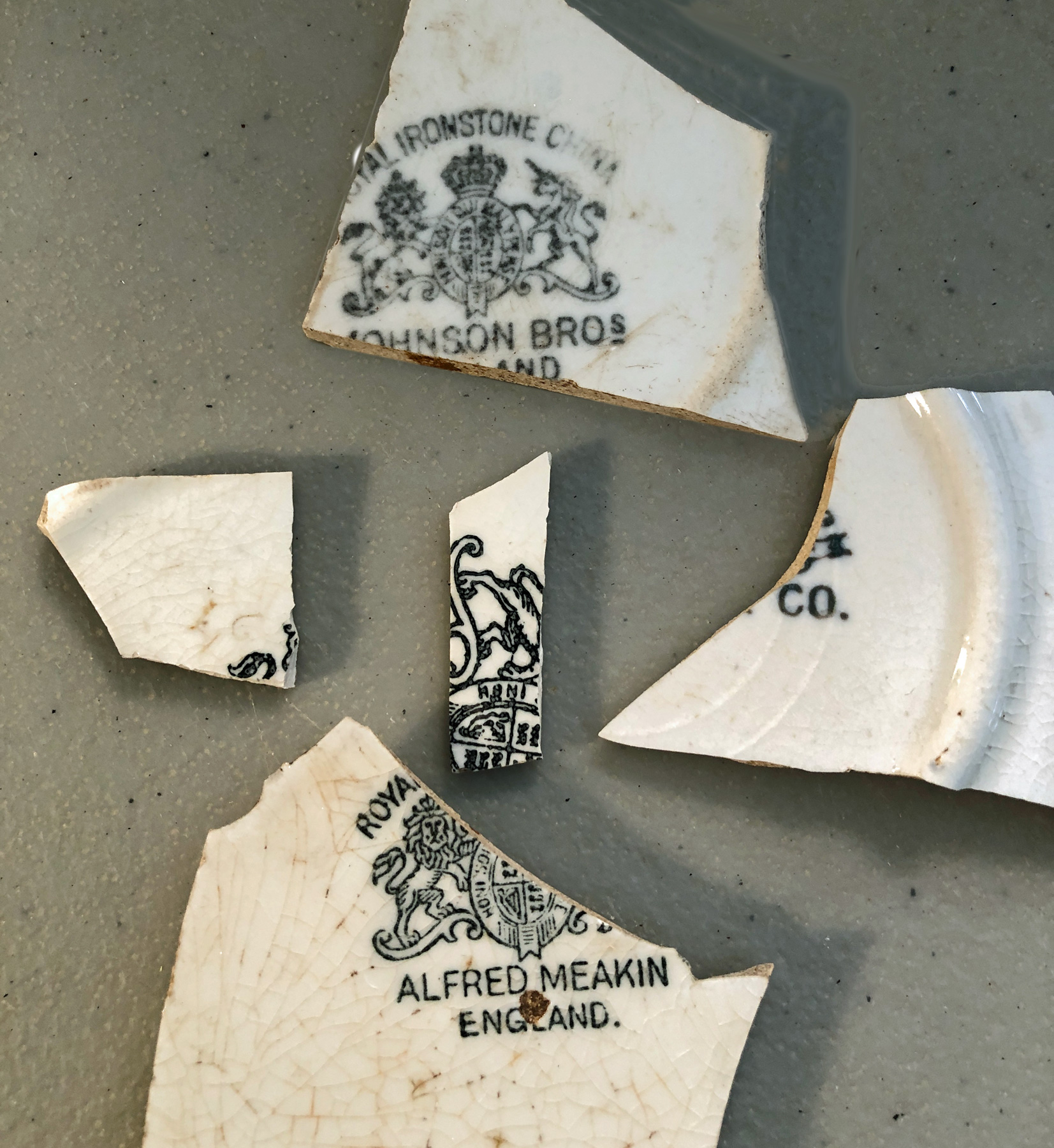
Denise, Linda, and Malinda worked inside Bruch House sorting the artifacts that were in the drying screens.  We chose these ironstone sherds with makers marks as the artifact of the day.  The Johnson Brothers mark dates from 1883-1913 and the Alfred Meaker mark is pre-1897.

It was a beautiful day to be outside.  Elsie, Claudia, and Mary dry brushed fragile oyster shells and washed other artifacts recovered from over the forge area.  
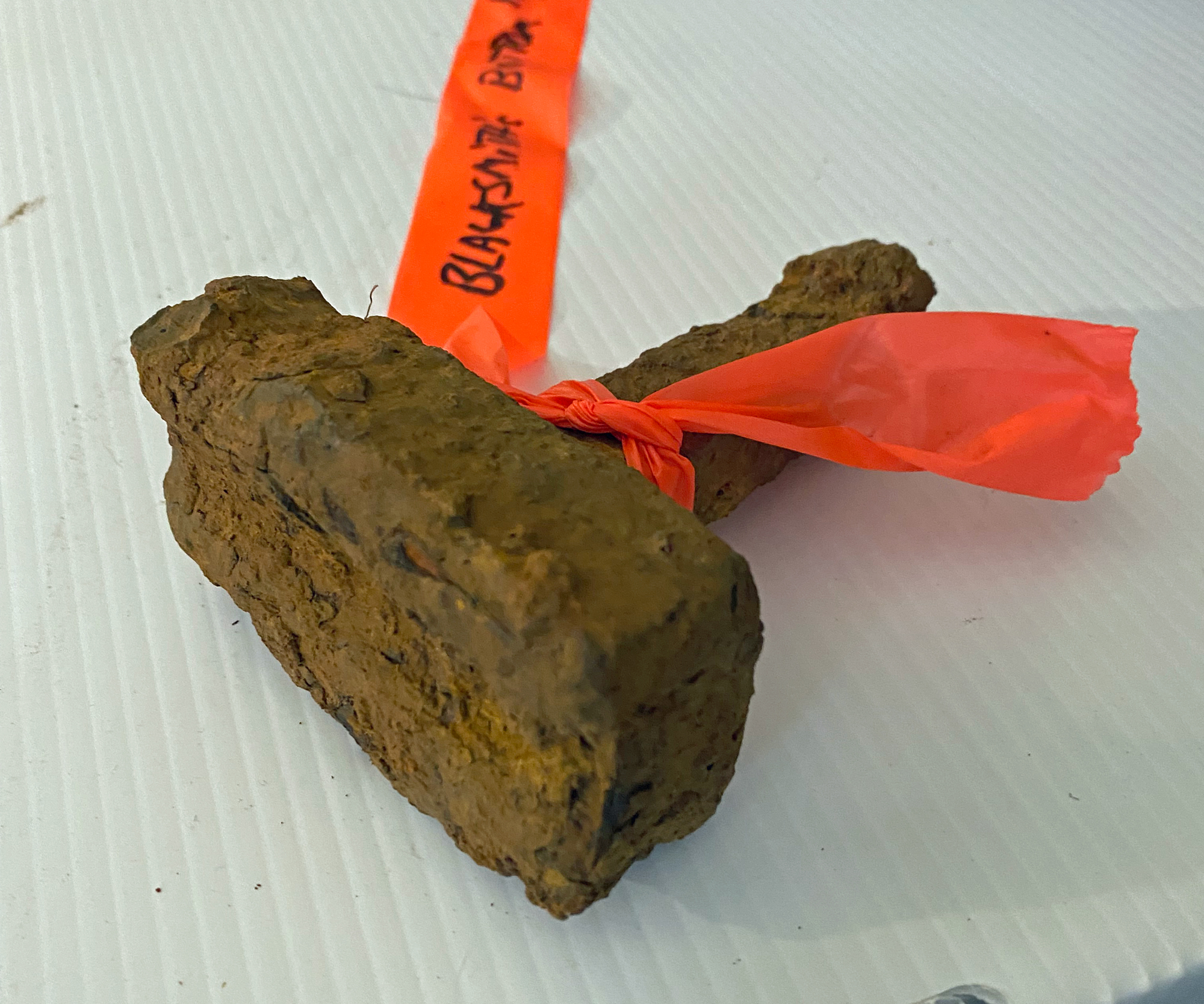
Ned, Peggy, and Carol dry brushed at least one bucket of rusty iron artifacts, and Ned attached flagging tape with possible id to those artifacts that he could identify.  In addition to a hub and bearings and possible carriage hardware, there were some cast iron stove pieces including a foot and what we think may be part of a stove door.  So maybe we have two artifacts of the day.


2022 Public Archaeology Lab Days (July-Dec)
2022 Public Archaeology Lab Days (Feb-Jun)
2021 Public Archaeology Lab Days (Mar-Dec)
2020 Public Archaeology Lab Days (Sep-Dec)
2020 Public Archaeology Lab Days (Jan-Mar)
2019 Public Archaeology Lab Days (Jul-Dec)
2019 Public Archaeology Lab Days (Jan-June)
2018 Public Archaeology Lab Days (July-Dec)
2018 Public Archaeology Lab Days (Jan-June)
2017 Public Archaeology Lab Days (July-Dec)
2017 Public Archaeology Lab Days (Jan-June)
2016 Public Archaeology Lab Days (July-Dec)
2016 Public Archaeology Lab Days (Jan-June)
2015 Public Archaeology Lab Days

June 7, 2023

CCASM Trip To Smithsonian Environmental Reseach Center

The Smithsonian Environmental Research Center (SERC) in Edgewater, MD, has multiple archaeological sites on the property - some investigated in the past, some currently being investigated and some waiting to be investigated.  Of SERC's  twenty-four research labs, one is dedicated to Archaeology. 

Jim Gibb who is a Smithsonian Research Associate and in charge of the SERC Archaeology Lab (SEAL) volunteered to give CCASM members a tour of SERC that highlighted the archaeology.  So we put together a trip.  On Tuesday June 6, a beautiful day, eleven CCASM members (Mary, Peggy, Linda, Pat, Carol, Denise, Elsie, Doug, Gary, Joe, and Ned) traveled to SERC.  Actually twelve members were on the tour since Jim is also a member.

All of us in front of Woodlawn

We met Jim at the new Woodlawn History Center.  At one time this housed the archaeology lab.   Jim and volunteers (Citizen Scientists) worked during the pandemic to help create the exhibits that are in the Center today.  Really interesting.  First, there was the history of the house with parts dating to 1735,  1841, or 1970.  Inside were all these displays, many with artifacts recovered from SERC, as well as stories related to the enslaved and free people who had occupied this property.  And we got to up to the second story and into the basement where we saw the "bones" of the building.  Outside Jim pointed out the terraces leading toward the Rhode River and the eroded landscape.

Viewing displays at Entrance
(previous location of archaeology lab)
Looking at 18th Century artifacts
recovered from the property

Jim had arranged to use a Smithsonian van to carry us to the other sites.  The first site was the Java Site that had much of the brickwork still standing, even after a hurricane.  Java dates to the early eighteenth century.  Jim also pointed out where the earlier seventeenth century Sparrow's Rest had been.  (There is no overall picture of Java since the brickwork in those photos took on a moire-like design.)

Learning about the Java Site
In front of one of the Java Chimneys

After viewing Java we piled into the van again and road on a dirt road over the hill toward the Rhode River to view the site of a slave dwelling that SEAL is currently working on.  Then we went back up the hill and traveled on the main road down to the Reed Education Center on the river.  Investigations before the center was built uncovered several shell middens.  We viewed the native fishes and a really pretty Diamondback Terrapin in the Center and then walked down to the dock to enjoy the breeze.  We decided to eat our lunch overlooking the water. 

After lunch we piled back into the van for a trip to the Charles McC. Mathias Laboratory in the Main Campus.  The archaeology lab that had originally been in the Sellman House has been here in the basement for a number of years.  Jim showed us around the lab and talked about the projects that the Citizen Scientists are doing on Wednesdays.  We also got to see some of the iron artifacts from Port Tobacco North that are being processed there.

James Gibb
Iron artifacts (in process)

Checking out the lab

Jim, thanks so much for providing such an informative and interesting tour of the site.  We all really enjoyed it.

Also thanks to Doug, Gary, Joe, and Ned for driving.  And thanks to Pat and Ned for providing additional photos.