March 12, 2023

2023 Charles County History Day and Science Fair

On March 11, 2023 the combined Charles County Public Schools Annual History Day  and the Annual Science Fair (now referred to as H.I.T.S.) was once again held at the St Charles High School in Waldorf, Maryland.  CCASM sponsored one of the special History awards and one of the Science awards.  In both cases the award was $50 and a one-year membership in CCASM.

Display - Hadrosaurus Foulkii

This year's history topic was "Frontiers in History: People, Places, Ideas”.  The CCASM Special History Award went to Hayden Robertson for the display titled "Hadrosaurus Foulkii, The First Full Dinosaur Skeleton Found in America".  Hayden is in the 6th grade at St. Mary's School.

The History Day judges identify projects with merit and assign them to one of the organizations sponsoring special awards. 


Display - Effect of Soil on
Bones Over Time


This year's CCASM Science Award for a project "demonstrating excellence and scientific thinking relevant to the field of archaeology" went to Mallory Chewning for the display titled "What Effect Foes Soil Have on Bones Over Time?".  Mallory is in the 6th grade at Milton M. Somers.

CCASM members review all the Science Fair entries and choose the project to receive this special award.


Congratulations, --- Hayden and Mallory!


CCASM would like to thank Carol Cowherd, Doug Zabel, and Gabi Zabel who judged the science projects for the CCASM award.


February 28, 2023

Volunteering with Dr. Julia King at Chapel Point Park

Dr. Julie King, Anthropology Professor at St Mary's College of Maryland, invited CCASM members to volunteer with her and her crew as they investigate a site in Chapel Point Park.  A plat shows a late 17th century house that was part of mission.  Also in the 1930s Native artifacts were found in this area.

Monday February 27 was the last day at the site.  CCASM members volunteered for part of the day, and the unit was closed today.  Ned was there most of the day.  Carol and Elsie volunteered in the morning.  Peggy volunteered for part of the afternoon.  It was Peggy's first time at the site, and she proclaimed it a beautiful site.  One of the more interesting finds of the day was part of a Starmaker School pipe that dates to the mid-1600's.  (Sorry no photo.)  Despite needing to cut paths through the woods and having to pick up thousands of small oyster shells, this has been a good site on which to volunteer.  All the crisp sunny days were great for being outside.  We can't wait to see the report that pulls together all that was recovered.


Friday February 24 Elsie joined Ned and Carol to volunteer with the rest of Julie's crew and with Carole, the volunteer from Virginia.  We all worked on the unit with all the shell.  Later in the afternoon the plow zone level was closed and a new level was opened.  I don't have the exact number of bags but it was over twenty with about four gallon-size bags being for lithics and three quartz-size bags being for "groovy" artifacts.  The rest of the gallon-size bags were filled with shell, mostly small fragments.  Julie stopped by in the afternoon to photograph some of the more interesting artifacts.  Here are three of the lithics we found - a steatite rim fragment, a Levanna point, and a core.  We also found several hand wrought nails today.  Quite an interesting unit. 


Thursday February 23 was an unusual winter day.  The temperature reached into the upper 70's.  A great day to be in the field.  Carol, Ned, Travis, and Carole, a volunteer from Virginia, worked in the unit that had all the shell while Caitlin and Garret completed excavating the other unit that had very few shells.  More shell meant more hands needed.  After four days at least eight bags of shell had been retrieved from the 'plow zone' level of this first unit.  We also found indigenous pottery, point fragments, Rhenish brown stoneware, hand wrought nails, and fire cracked rocks

Wednesday February 22 Ned volunteered the whole day working with Travis and Garrett  in the unit that had lots of shell but also in which a 17th century stoneware sherd had been found.  Carol volunteered for most of the day with Caitlin and Meagan in the newly opened unit that had very few shells but also had point fragments, stoneware sherd, hand wrought nails, and fire cracked rocks.  Julie visited the site in the morning to assess the erosion along the shore. 


On February 21 Julie's crew opened up one 5'x5' test units, and CCASM was notified that night that our help would be appreciated.

Tuesday February 14 the crew and volunteers finished up the marked set of STPs that were spaced 25' apart.  Ned helped Garrett with STPs.  Carol volunteered for part of the day and helped Caitlin with STPs.  Among the things found were a quartz projectile point midsection and a rim fragment from a red clay tobacco pipe.  Not sure if any additional field work is planned. 
Like the other days that we have volunteered this day was sunny and not that cold.  This winter has had many wonderful days for working (or just being) outside.

Friday February 10 Carol volunteered during the morning and helped Garrett with STPs.  The other volunteer also named Carole (but with an e) helped Caitlin.  Among the things we found were a Native American pottery sherd,  a piece of olive green glass as well as one of clear glass, and a possible weight/sinker.


On February 8 and 9 Ned volunteered to help clear the STP lanes and set the flags for the new STPs  (25 feet apart).  These STPs were in an area of interest.  It was another pair of nice winter days.  Actually it was a little too warm to be cutting STP lanes through brush and fallen trees. 


Tuesday February 1 Ned again volunteered at the site.  Carol also decided to come out for a few hours after the snow had melted.  (The weather was too nice to stay home.)  There were two other people also volunteering.  Carol helped Caitlin with STPs.  Ned worked with Isabel, another woman that volunteers with Julie, and the two of them finished a number of STPs.  We were working closer to the Point.
Julie stopped by for a few minutes and indicated there were two areas of interest based on the initial STPs.
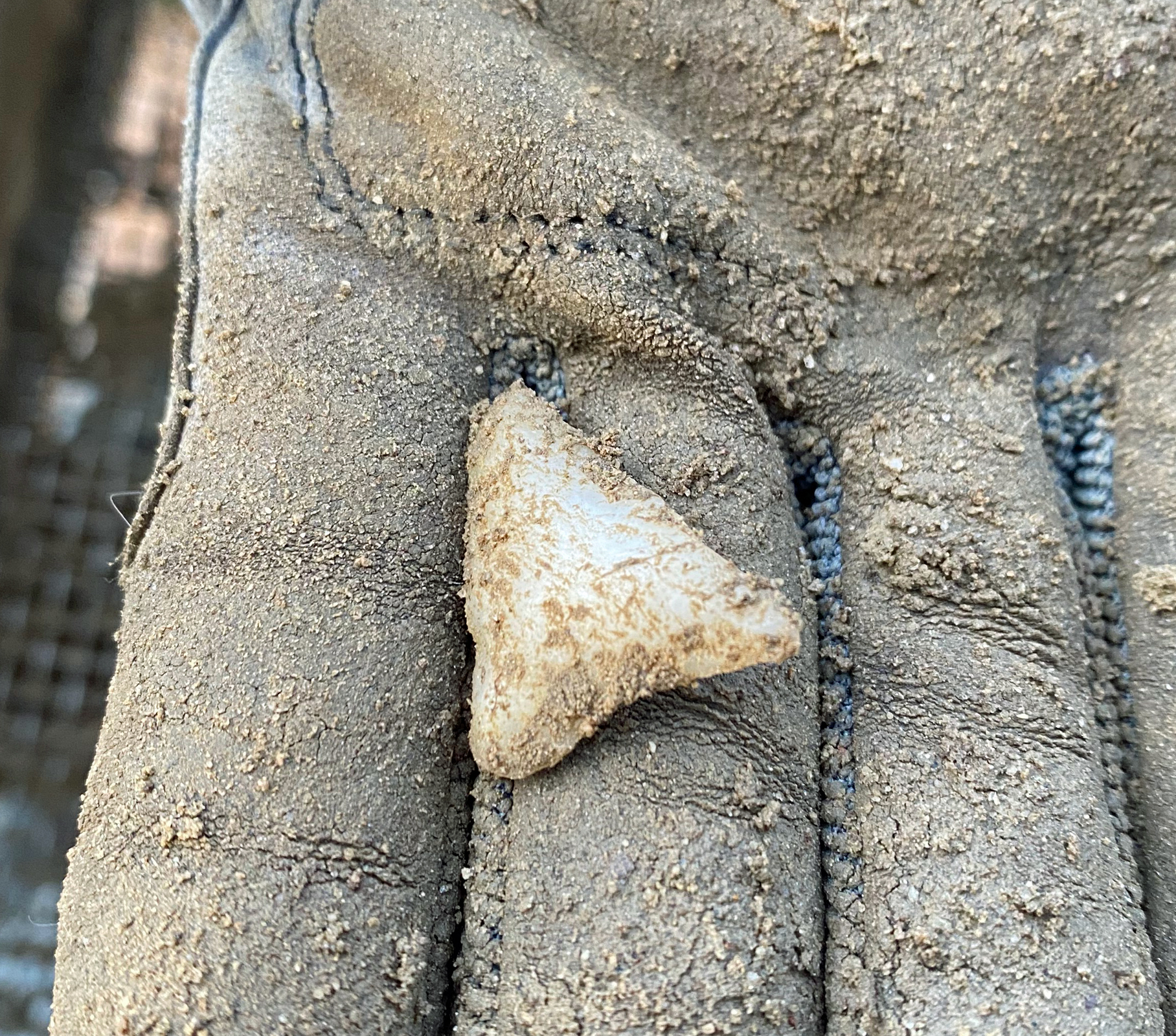
Friday January 27 Mary joined Ned to volunteer at the site.  Ned and Mary helped Caitlin screen STPs, and Mary found this triangular point (Late Woodland).  Again it was a beautiful day.


Thursday January 26 Ned once again volunteered at the site and continued to help clear thickets and cut lanes. One highlight was Caitlin finding the base and midsection of a quartz point at Fourth Point.  The day was a little overcast, but here is the view from Fourth Point.


Tuesday January 24 Ned and Carol volunteered at the site.  It was a beautiful day.  Ned worked with Caitlin, and Garret to continue laying in lines for an additional 100 STPs in the western part of the site that includes the point.  Carol worked with Aiden for a partial day to complete digging the STPs in the eastern part of the site.  Aiden then started digging STPs in the new area.  There's still a  lot to do.

Friday January 20 Carol joined Ned to help Caitlin screen STPS in the morning. The sun was out, there was little wind, and it was fairly easy to travel through the woods.
In the afternoon the crew moved to a different area and here is Ned's update on that area--
BRIARS! BRIARS! BRIARS!  Caitlin, Garrett, Aiden, and I cut more lines through BRIARS, REALLY BIG BRIARS, after lunch. Carol didn’t seem interested in BIG, BIG BRIARS and went home.  Our CCASM president has more sense that I do obviously. I had fun despite the loss of blood.  First photo below is an earlier area we had to cut through. The other two photos were in the last area we cut through showing what a great path we made.  See what you missed!


Wednesday January 18 Ned again volunteered with Julie's crew.  Here is Ned's update--
We cut lines on the southern end of the forest in the morning. Some of these were short and perpendicular to the east/west lines. Flags were set 50’ apart, and the lines are 100’ apart. The first STP that Caitlin dug had very wet clay that wouldn’t go through the screen.  The next STP we did was dryer and passed through the screen.  I found a blackened plain ceramic about 3/16” thick and about 1.25” square.  Caitlin was very happy with this ceramic. The STPs closer to the Port Tobacco River had a good bit of oyster shell. We found a few quartz flakes in a few of the STPs.  At an STP in the wheat field, I found a narrow bore, 1” long, white pipe stem which also pleased Caitlin.

Monday January 16 CCASM member Ned volunteered at the site.  Here is the information he provided--
Today at Chapel Point  three members of Julie's crew--Travis, Hanson and Aiden-- dug STPs.  I helped two other crew members -- Caitlin and Garrett-- cut lines from a wheat field through a pine forest to Port Tobacco Creek .  While the pine forest is relatively open, there were major thickets of fallen trees and heavy vines to cut through.  I think we cut at least five 200-yard lanes. Caitlin and I did most of the clearing while Garrett set the flags about every 50 feet.  I had fun, but it was a very tough job even with the heavy-duty tools I brought. 
Plans are for the crew to work Wednesday and Friday.  There are threats of rain on Tuesday and Thursday.

Thanks to Ned for the info and the photos.

February 17, 2023

Centers of Exchange: Comparing Virginia's Northern Neck and Maryland's Potomac Valley

Caitlin Hall
At the February 16 CCASM meeting Caitlin Hall talked about three Indigenous sites -- Baylor and Camden in the Virginia Northern Neck, and Posey on the Potomac in Charles County, Maryland. Artifact assemblages indicated these sites may have served as trading posts.  Caitlin pointed out that in Maryland, the Calverts used exchange relationships to maintain Indigenous leaders, reinforcing Indigenous structures of authority while displacing them from the land. However, the unique position of the Northern Neck weakened the control of the government, allowing Indigenous people to construct trade relationships outside political structures of the colonial government.

Baylor, Camden, and Posey Sites


After answering our questions, Caitlin showed scenes from the 2023 Society for Historical Archaeology Conference in Lisbon, Portugal as well as photos of sights the group were able to visit during their limited time there.  In January Caitlin had presented this paper at the 2023 SHA Conference.

Caitlin Hall is a May 2022 graduate from St. Mary's College of Maryland where she was a Valedictorian.  Caitlin majored in Anthropology and History.  She currently works for Dr. King as an Assistant Archaeologist and plans on attending graduate school Fall 2023.


Members and Visitors before the meeting

Attendance: 14

January 21, 2023

Survey of the U-1105

Aaron Hamilton
At the January 19 CCASM meeting Aaron S. Hamilton provided an update on the underwater survey of the U-1105 German submarine shipwreck that the Battle of the Atlantic Research and Expedition Group (BAREG) is doing for the State of Maryland.  In additional to indicating the current state of the wreck, Aaron talked about the historical significance of the U-1105 and its four evolutionary technologies   Aaron was able to provide some of their findings but the final report will not come out until next year.  Overall it was quite an informative talk.

The U-1105 shipwreck preserve is off Piney Point, Maryland.


Aaron S. Hamilton is a published historian and avocational maritime archaeologist trained through the Nautical Archaeological Society. He is a founding member of the BAREG and has participated in both fieldwork or research on nearly a dozen surveyed wrecks from World War II. 
BAREG is focused on historical research of topics related to the maritime campaigns waged between the Allies and Axis/Central Powers during 1914-18 and 1939-45, diving wrecks associated with these campaigns, and documenting their current conditions via photography and/or videography.

A special thanks to Aaron for battling the Beltway traffic to travel to Charles County.

Members and visitors before the meeting

Attendance: 16


January 9, 2023

Fieldwork for Village of Port Tobacco Green Parking Lot

CCASM members along with other volunteers will be working with Charles County Archaeologist Esther Reed to survey land on which the Village of Port Tobacco plans to build a "green" parking area.  The parking area will allow visitors to more easily access the the Port Tobacco Village Agricultural Heritage Museum as well as the nearby One-Room School House.  The Village has applied for a Southern Maryland Heritage grant to help fund this. 

The survey will involve digging STPs on the proposed site for the parking area.  The site is on Chapel Point Road between the One-Room School House /Causeway Road and Murphy's Store (map).   We refer to the site as the Port Tobacco Barn site.

Upcoming dates are TBD

Around the end of the year Esther submitted a site form for this site  The site will now be referred to as the North Port Tobacco Site and has site number 18CH998.

Tuesday November 22 CCASM members Elsie and Steve along with James and Wes volunteered with Esther to retrieve additional metal artifacts from the blacksmith area.  Wes who was surveying the site also helped by sighting in the location of the exposed building footprint as well as the the loci used to determine the location of the STPS.
 
On Monday November 21 CCASM members Denise, Joe, Mary, Gary, Elsie, Ned, and Steve along with James volunteered with Esther to excavate part of the footprint of the building, to excavate and screen a 17'x4' area referred to as 'above the forge' and to continue to retrieve metal and other artifacts found on the surface.

Around November 15 the Village had the woods to the north bulldozed to remove the trees so that the green parking lot could be built there.  In an area that the brush was so thick that we had not been able to penetrate it, the bulldozer uncovered a building that could have been a blacksmith shop - lots of metal.  


Wednesday November 9 CCASM members Mary, Gary, and Ned volunteered with Esther to continue to dig STPS in the woods.  We had to cut paths through the underbrush in order to reach the areas where the SPTS were to be dug. 

Monday November 7 CCASM members Pat, Denise, Mary, Ned, and Elsie started digging STPs in the woods on the northern part of the site while Carol worked with Esther to measure location of key flags relative to the the east and west corners of the corn crib.  The most interesting thing we found was a label that is probably for a bottle of mirage perfumed oils.  The language is Farsi.  It was  on the surface.

Monday October 31 CCASM members Elsie, Pat Ned, Denise, Carol, and Evelyn were joined by James to volunteer with Esther on continuing to dig STPS.  Ned, Pat, and Elsie spent all morning competing their STP that was dug by levels while the rest completed all the STP locations flagged in the grassy area.  Since a couple of the STPs next to the woods contained early eighteenth century ceramics (not that much, but still...), additional STP locations were flagged in the woods by Elsie, Ned, and Esther.

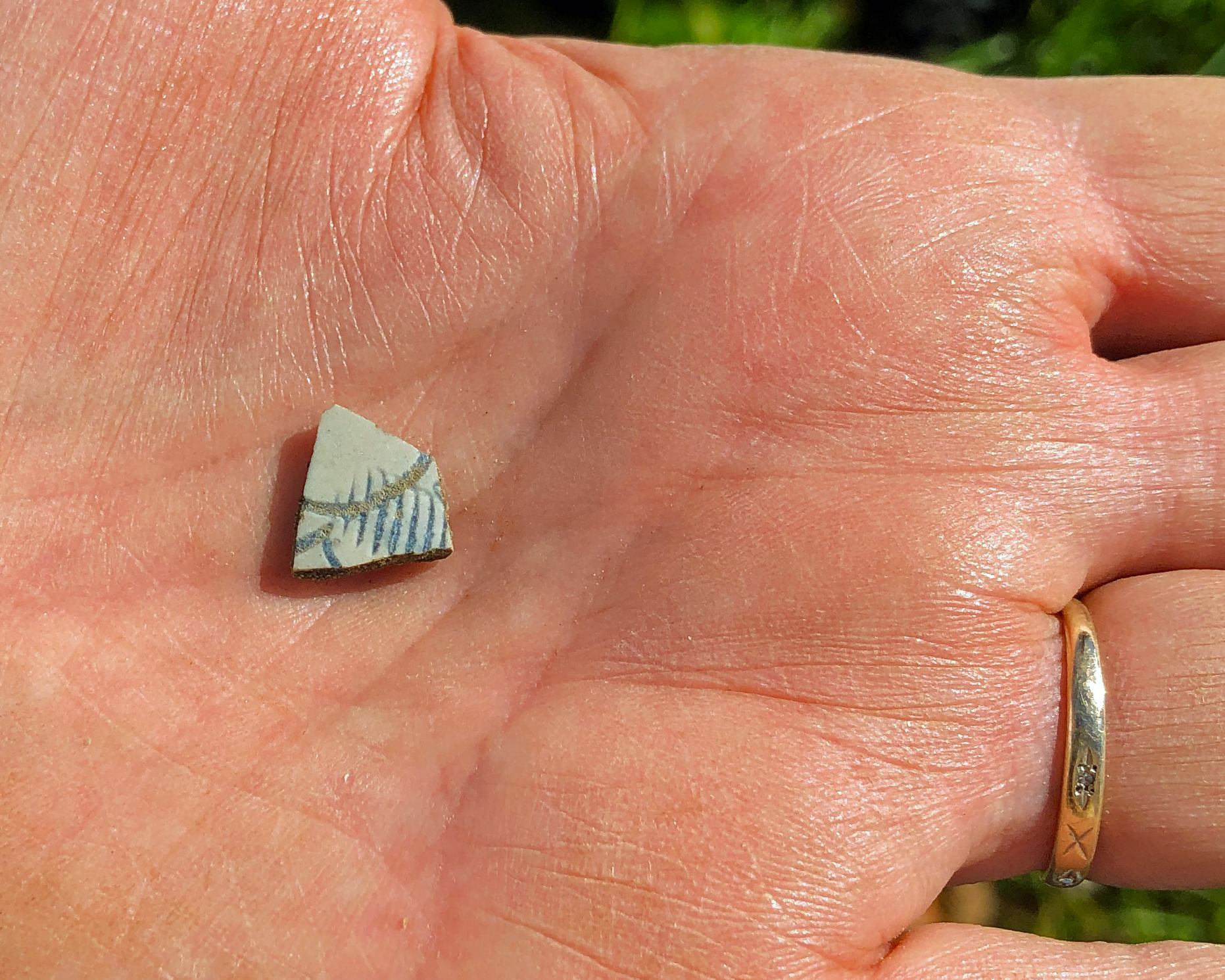
Sunday October 30 CCASM members Elsie, Pat Ned, Peggy, Carol, and Evelyn were joined by Tim to volunteer with Esther on continuing to dig STPS.  And we even choose an artifact of the day - this small sherd of early eighteenth century scratch blue white salt glazed stoneware.  We've found a few other small interesting artifacts, but this is the first we decided to share.


Saturday October 29 CCASM members Elsie, Denise, Joe, Ned, Peggy, Carol, and Evelyn (who drove up from South Carolina) were joined by Tim to volunteer with Esther on continuing to dig STPS.


Monday October 24 CCASM members Linda, Elsie, Denise, Ned, Pat, Steve, and Carol were joined by Malinda and James to start the survey of the area to the north of the corn crib.  Esther Reed is the principal investigator.


STPs were to be dug at 25' intervals, and the locations were flagged.  We were able to dig about seventeen STPs, and they were all at least two feet deep.  This is an area where there could be soil deposits from a nearby flooded creek as well as soil eroded from the nearby hills.  It is an area where there could have been Portobaco Indians.  This was also part of the 1729 Charles Town also known as Portabaco and of the earlier Chandlers Town.  We did find a few artifacts but nothing to indicate anything significant that would impact the development of the parking area.