October 9, 2018

Salvage Excavations in Dentville


Simpkin Coatback (CH-657) is an 18th century Yeoman farmer's house in Dentsville that has a demolition permit on it. We have until mid-October to investigate around the house before the bulldozers come.  The Principal Investigator is Esther Read, Charles County Archaeologist, and archaeologist Jim Gibb along with CCASM volunteers are helping.

Remaining dates:  
      No additional fieldwork

It's not necessary to be there all day to help out.  But remember to bring water.

On the afternoon of Monday October 8 there were three "teams" digging STPs - Evelyn and Julie; Denise and Joe; Linda, Elsie, and Carol - while Esther cut down the weeds, etc. around the flagged areas where STPS were to be dug.  Not that many artifacts recovered.  The soil profiles seemed different.  We assumed this would be our last day at the site.


Sample of Artifacts from East Test Unit
Regulars Jim, Esther, Evelyn, and Elsie were joined by Central chapter members Steve and Barbara and by Kyla (a graduate student @ UM) and her friend Emerson on Sunday October 7 .  In the morning we opened up a unit on the East side of the house where a concentration on early artifacts had been found in an STP.  We also opened up another unit on the West side of the house near a standpipe with electrical wiring.  Our search for a dug well in this unit was non conclusive.  We hit subsoil or possible fill that was not typical of the subsoils found elsewhere on the site.  We dug a number of STP's that we had not been able to complete last weekend.  Esther and Evelyn laid in a couple of rows of STP's in the field to the West of the house near one of the outbuildings.  We will have to cut down the the tall grasses around these STP sites before we can excavate them.  By mid afternoon the high humidity and strong sun on the west side of the structure became very oppressive and we quit earlier than normal.   (Thanks to Elsie for the write-up and photos.)
Dynamic Gardening
Documenting Shallow STP

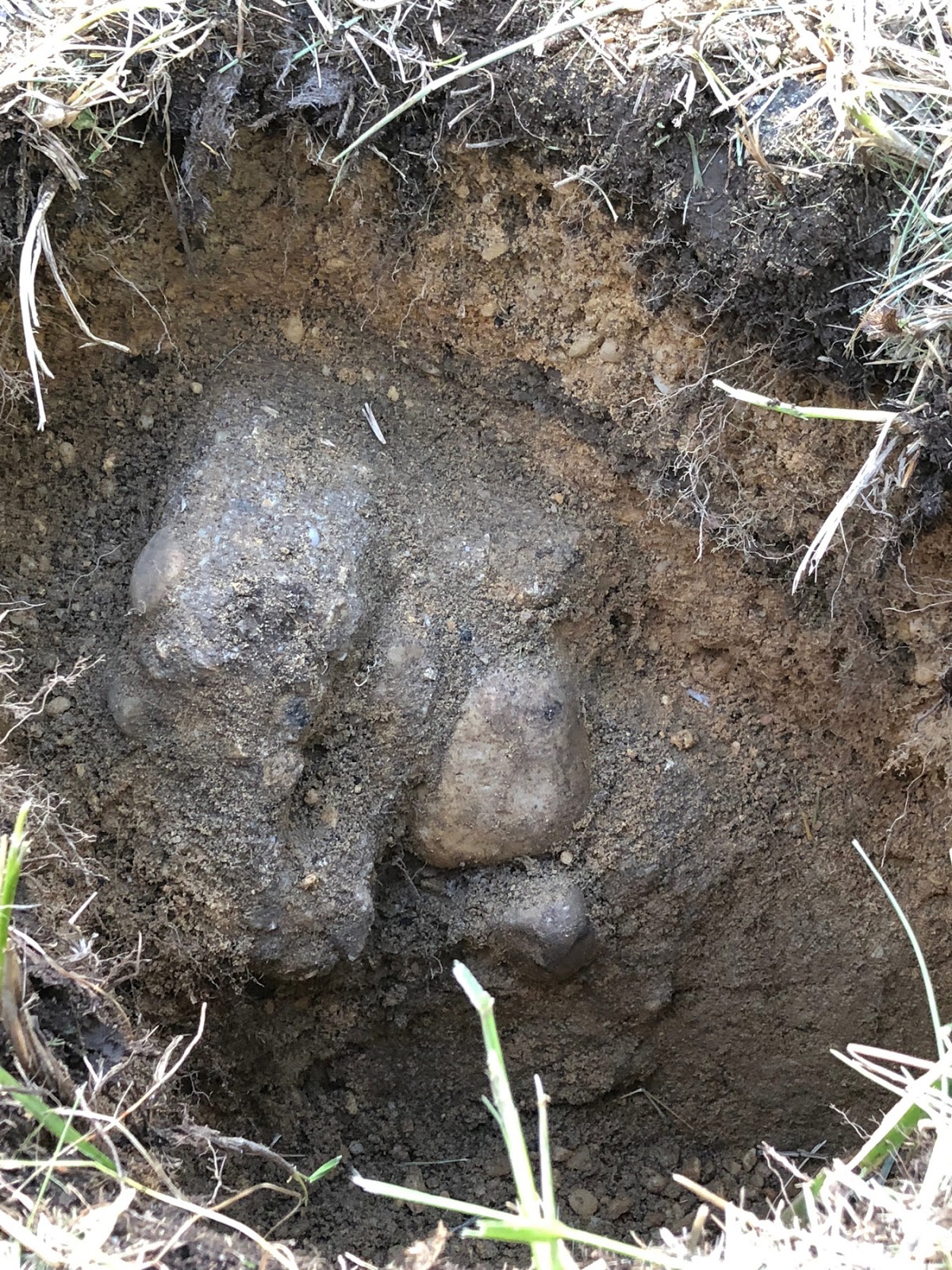
Rocks in STP
Sunday September 30 we spent another full day at the site and excavated around the house.  STP grids were put in around the remainder of the house's yard.  The total count to date is now fifty STPs and one test unit with five strata.  At the end of the day, we encountered what may be part of a building.  The top few inches and east half of the STP was filled with gravel intermixed with a little sand and a few artifacts.  On the west half of this STP was a stack of rocks that could not be budged.
Those at the site (a few active and previous CCASM members but mostly volunteers living outside Charles County) included Jim, Elsie, Pat, Carol, Steve, Lisa, Adam, Erin, Lydia, Carl, Stephen, Barbara, and Esther.
We will be washing artifacts Monday.
Excavating Shovel Test Pit
Another Shovel Test Pit
Completing Test Unit 1


Saturday September 29 was our first full day at the site and the first day with no rain.  Among those at the site (both active CCASM members, previous CCASM members, and others) included Elsie, Denise, Pat, Julie, Carol, Sarah, Steve, James, Linda, Camille, Lisa, Phyllis, Tim, and Esther, of course.  Fifteen people volunteered for at least part of the day.  STP grids were put in the yard on the north of the house, and we dug over fifteen shovel test pits.  Most had only a few artifacts, and some had no cultural material.  But in one STP a row of bricks was encountered, and a small test unit was dug next to the STP.  A relatively large number of artifacts were recovered from this unit.  The house and yard are on a small rise.  Metal detecting was done in the area north of the yard.  An STP was dug at each hit to recover all artifacts, not just the metal, and to record information about the location.
Test Unit 1 next to STP
Excavating Shovel Test Pits
Excavating Test Unit

 Monday September 24 there was a break in the rain.  So after lunch the Port Tobacco Monday Lab was closed.  Julie, Denise, Linda, Carol, Mary, Elsie, and Esther drove to the site and started digging STPs.  About 2:30 the rain returned, but we did finish five STPs with probably less than a hand full of artifacts recovered. 

The weather didn't cooperate on Sunday September 23.  All that could be done was to walk the land.  It was raining too hard to even lay out lines for the STPs.  Here Esther, Evelyn, Jim, and Tim are taking shelter in one of the barns.

September 14, 2018

Archaeology of the Paleoindian Period

Zachary Singer
Following the summer break CCASM monthly meetings started again on September 13 with a presentation by Dr. Zachary Singer about "Archaeology of the Paleoindian Period (13,000-10,000 calendar years before present)".   The Paleoindian Period begins at the end of the last ice age when humans first appeared in the archeological record in North America.  So Zachary covered the various hypotheses of how humans came to North America as well as described the various stone tools and technologies associated with pre-Clovis, Clovis, and later Paleoindian sites.   Since most organic materials do not survive in the acidic soils around here, only the stone artifacts remain.

Catching up before the Meeting
During the Presentation

Zachary Singer is the Public Programs Coordinator for Anne Arundel County Government’s Division of Cultural Resources and The Lost Towns Project, Inc.  For more information about volunteering with the Lost Towns Project contact Zachary at volunteers@losttownsproject.org

Attendance: 16

August 26, 2018

Historic St Mary's City Archaeology Lab and Curation Facility Field Trip

Saturday August 25 nine CCASM members traveled to Historic St Mary's City for a special tour of HSMC's Archaeology Laboratory and Curation Facility.  This is where artifacts from Maryland's first colonial capital are cared for and housed.  The Lab is only open to the public once a year during Tidewater Archaeology Weekend.  However, Silas Hurry, Curator of Collections and Archaeological Laboratory Director, gave a special invitation to CCASM members to have a guided tour of this new state of the art facility.

We started in the room where artifacts would be received into the building and followed the artifact's path through this three-story "building".  Along the way we saw numerous artifacts and heard a lot about what went into creating this facility.  Really interesting.
 
Where artifacts are catalogued
Silas Hurry
On the balcony

After a seafood lunch several of us visited the St John's Site Museum that preserves the foundation of the home that stood here throughout the 17th-century (https://hsmcdigshistory.org/pdf/St-Johns.pdf).   This was move-in day at St Mary's College and many of the roads were one-way.  So Aaron gave us a special escort to the Museum.
At St. John's Site Museum
St John's Site within Museum
CCASM would like to give Silas a special thanks for the tour as well as for facilitating our visit to the St. John's Site Museum.

August 24, 2018

Pomonkey North Site added to Maryland Unearthed

The Jefferson Patterson Park and Museum web site (jefpat.org ) has a number of Archaeology Research Tools including "Maryland Unearthed".  Maryland Unearthed is a guide to many of the important archaeological collections maintained by the Maryland Archaeological Conservation Laboratory, the state's central curation facility.

The guide only contains sites investigated at the Phase II and/or Phase III levels.  And now Pomonkey North (18CH73) has been included.  CCASM started investigating 18CH73 in 2012 and completed documentation in 2016.

There are sites from all over Maryland including twenty-four sites in Charles County.  To check out Maryland Unearthed, go to http://jefpat.org/mdunearth/

August 6, 2018

2018 Fieldwork at Stagg Hall

On a pretty but very humid Saturday August 4 CCASM members and other volunteers joined Charles County archaeologist Esther Reed along with fellow archaeologist and CCASM member Jim Gibb to investigate what was behind Stagg Hall.  A 20-foot grid was laid out, and we dug fourteen shovel test pits (STPs) at the grid intersections.  As expected we found artifacts ranging from the eighteenth through twentieth centuries.  But in one area we also found these two Native American artifacts - a quartzite utilized flake and the tip of a rhyolite projectile point.  Somewhere in or near Port Tobacco was the Portobac Indian village of the Portobac Chiefdom.

Utilized Flake
Projectile Point Tip

And here are some Photos of us digging and screening.  (The house in the background is Chimney House that is adjacent to Stagg Hall.)

Denise, Linda, Joe, Esther
Esther, Maggie
Elsie, Julie
(Andre),  Jim, Elsie, Julie
CCASM members participating were Denise, Joe, Elsie, Julie, Jim, and Carol (not pictured).  Other volunteers included Maggie, Linda, and Pat (no picture).  And Esther was the principal investigator.